Uncategorized

Sat 27 Sep 2014

World Peace Pagoda, Pokhara

World Peace Pagoda, Pokhara

The weather was much better today — some showers in the morning and light drizzle in the evening, but the afternoon was quite clear. I took advantage of this and walked to the World Peace Pagoda at the top of a hill on the other side of Fewa Lake.

First I needed to charge my camera batteries, as I had forgotten to charge them overnight. Conveniently it rained while I camped in my room through the rest of the morning, waiting for the batteries to charge.

Just before noon the sky cleared and I ventured out in the direction of the steep hill where I could see the Peace Pagoda in the distance. I asked directions of a few locals along the way, and following their advice I eventually crossed a wooden suspension bridge over the Pardi Khola (river) then began the ascent by climbing some stone steps to the right at the end of the bridge.

The trail began as a wide road, but there were no signs (in English or any other language) indicating the direction of the pagoda. I eventually asked a young man who also appeared to be a tourist but it turned out he was a local Nepali just taking his wife and young children on a Saturday walk in the direction of the Pagoda. He showed me the way up a steep hill into the heavily wooded hillside and I followed them on the trail for a while. They were going quite slowly since the children could not walk very fast, so after some time I overtook them and followed the clearly established path for another half hour or so.

Then I got a bit lost. There were a few forks in the trail and eventually I took one! However that path eventually became less conspicuous as it disappeared into the underbrush, so I retraced my steps back to the main trail, which no longer seemed to be ascending. I reasoned that the pagoda was at the top of the hill so I needed a trail that was ascending. I tried a few other offshoots that were clearly ascending but they also seemed to disappear into the underbrush.

I again retraced my steps and wondered what to do next. For the last half hour I had encountered no other tourists and only a few Nepalis (who did not speak any English) — there was a man fishing at a small pond and some elderly women in traditional clothing who seemed to be foraging. I decided the only option was to return to the main trail in hopes of finding someone who could provide me with some guidance on which direction to go. Otherwise I would have to return to the city without attaining my goal of reaching the pagoda.

As I was trudging back through the underbrush — lo! there appeared before me two young American guys who were also seeking the pagoda. I reviewed with them my various explorations up to this point, and as we were discussing which direction to try next, one of them (Antonio) spotted the pagoda through the trees, a few hundred yards to our right and further up. Somehow Antonio beat a path through what vaguely appeared to be a trail through the trees and underbrush and got us onto a ridge on which there was a path heading straight for the pagoda.

There was a small restaurant at the base of the pagoda and we stopped to rest and chat for a while. I learned more about my trail companions. They had met in university and were recent grads; Antonio was living in Kathmandu and Gus was visiting him after spending a few months in India.

Antonio was from Catskill, NY, and was spending a year in Kathmandu working as what he called a “catalyst” at a local school. He was helping the children with their English studies and informally teaching them Spanish as well.

Gus was traveling the world for a year while working on a fellowship of the same duration. Specifically he was researching the social impacts of dams throughout the world, and among other things documenting his findings in a blog (riversolitaire.wordpress.com).

I asked whether he would be researching the Three Gorges Dam in China, variously called the “worlds most powerful dam,” as well as “an environmental catastrophe” and “a model for disaster.” It has even been alleged that the dam has slowed the earth’s rotation (so if it seems like your days just keep getting longer and longer: blame the Chinese). Gus said that he had been advised not to attempt to research the dam, much less document his findings, due to several factors, such as Chinese censorship, Chinese citizens’ likely reluctance to talk about the project for fear they may be punished for doing so, and not least, the risk that he himself could face “trouble” with the Chinese authorities.

After 20 minutes or so they left to ascend to the pagoda further uphill, while I waited for some momos I had ordered (I clearly was developing an addiction to momos — I needed mo! and mo! momo!).

After consuming the momos I made my way up the stairs to the pagoda, which was built by a Japanese monastic organization in 1992. The sky was a bit hazy but there was still a great view of Fewa Tal and Pokhara City down below. I also got a better view of the paragliders sailing around in the currents above the hill behind Pokhara.

Alcove, World Peace Pagoda

Alcove, World Peace Pagoda

View from World Peace Pagoda

View from World Peace Pagoda

View of World Peace Pagoda from Pokhara

View of World Peace Pagoda from Lakeside, Pokhara

On the way back down I again had some trouble finding the correct trail but eventually made it to the bottom of the hill, only in a different place from where I started. All around me were rice paddies and the smell of livestock was so strong that I began to enter an altered mental state. However with the help of some locals I finally made it back to the main road and back into the city.

IMG_2438

“And I Ended Up in the Middle of a Rice Paddy”

Standard
Uncategorized

Fri 26 Sep 2014

Fruit Seller, Lakeside, Pokhara

Fruit Seller, Lakeside, Pokhara

After breakfast at the Boomerang Restaurant (where the WiFi password was “kangaroo99”) I stopped at a few trekking agencies to enquire about options for treks over the next few weeks. It seemed that the best options would be a six-day trek to the Poon Hill viewpoint, at around 3200 meters, or a ten-day trek to the Annapurna Base Camp, at around 4000 meters. I was hoping to join a group, but none of the agencies had any availability for me to join up. I left my mobile number and email address and they said they would contact me if some options materialized. They explained they could arrange a trek for me alone, but the cost of course would be higher than sharing a guide with others in a group.

I continued to explore the town on foot for the next hour or so. I had an inexpensive and substantial thali style lunch at a local restaurant, ending with a tasty masala tea. In the afternoon the rain commenced again, so I stayed in my room to do some reading and writing. The shower cooled the air and the percussive white noise of the steady downpour was soothing. Sure enough, I fell asleep for a few hours.

September is officially the end of the rainy season in this region, so I was looking forward to better weather soon.

A Tree in Lakeside, Pohara

A Tree in Lakeside, Pokhara

Standard
Uncategorized

Thu 25 Sep 2014

View of Fewa Tal from Lakeside, Pokhara

View of Fewa Tal from Lakeside, Pokhara

The bus station was conveniently a few minutes’ walk from my Kathmandu hotel, so I packed up the two bags that carried my current worldly possessions. I put on the backpack and slung the other bag over my shoulder. Several sources had told me the bus ride would be “six to seven hours,” but I reminded myself that they were speaking in Desi time, which really meant “eight to nine hours or maybe longer – who knows?” Amazingly, the bus left on time, and I was installed in the middle seat in the back row, so I had room to stretch my long legs during the journey.

Now, Google Maps indicates that the distance from Kathmandu to Pokhara is all of 202 km (125 miles), which on a U.S. or Canadian highway would take less than two hours. But to cover this distance here in Nepal the road rises, falls, and curves around hills and mountains. At times we proceeded more slowly than a snail on a bicycle, meaning we were stopped altogether for long periods. There was very heavy traffic, consisting mostly of trucks and some buses, trying to push both ways through narrow, winding roads, leading to bottlenecks and blockages.

Next to me on the bus was a young Japanese woman going to Pokhara to meet up with her guide for a six-day trek into the Annapurna area. She said she worked in a department store selling children’s clothing, and since, like most Japanese, her job only gave her 15 vacation days per year, she had quit her job in order to travel for a few months. In the last several weeks she had already traveled around China and Myanmar, and Nepal was her last destination prior to returning home to Kyoto (n.b.: my fellow traveler informed me that if you see Hello Kitty in Kyoto, she will be wearing Kimono). She had studied English in Australia for three months and was very fluent so we had no trouble communicating. Clearly she enjoyed traveling — she said she had been to over 50 countries! We shared some stories of countries that both of us had visited, and she gave a happy thumbs up for Thailand, where I was planning to go after visiting family in South India.

We finally arrived in Pokhara around 4:00 p.m. I was able to orient myself by reviewing a few Lonely Planet maps, and (smartly as it turned out) I waved off the taxi drivers and followed the street around the lake until I reached my hotel, less than ten minutes from the bus stop.

Entrance to Hotel Nirvana, Pokhara

Entrance to Hotel Nirvana, Pokhara

Hotel Nirvana was nicely situated several minutes’ walk from the busy tourist strip, almost hidden behind its front garden. After checking in I had planned to take a stroll into the central area to have dinner, but the skies opened up and poured down a torrential, constant shower of rain for a few hours. So I raised my umbrella and walked right across the street and had a pizza at the Caffe Concerto, where I also availed myself of their fast WiFi connection.

Finally the rain subsided and I walked up and down the tourist strip, observing the signs for the various hotels and bars, and peering into some of the shops strung along “Lakeside” as this area is called, since it borders Fewa Tal (lake).

Pleasant Plants Near My Door

Pleasant Plants Near My Door

Fewa Tal at Dusk

Fewa Tal at Dusk

Standard
Uncategorized

Wed 24 Sep 2014

View of Boudhanath Stupa from Rooftop Cafe

View of Boudhanath Stupa from Rooftop Cafe

When I booked my stay at the monastery, I told them I would be leaving today. However, over the last few days I considered extending my stay by a few more days. I was enjoying having the company of like-minded people and it certainly was much more peaceful at the monastery compared to Thamel. In the end I woke up this morning with the idea of going back to Boudhanath to take some photos (I neglected to take my camera when I went on Monday) and then returning to Thamel in the afternoon.

Bram also wanted to go back to Boudhanath — he said he had gone in the evening when it was dark, and he wanted to see what it looked like during the day. So we set off after breakfast, this time taking a more direct route, as we followed some monks going in the same direction.

Once we got there we went up to the elevated base and did one circuit around, as Bram was unable to do this at his last visit. We strolled around on the street a bit and then had a cup of tea, at a different rooftop restaurant than the one I had gone to with Paola on Monday.

Bram spoke fluent English, French and Dutch, and when I asked if he spoke Flemish, he answered in the affirmative, but also explained to me that Dutch and Flemish are basically the same language but with different pronunciation. In fact, he said, they are written in exactly the same way, as evidenced by the joint Dutch-Flemish spelling bees that Bram told me about.

I learned that Bram had just completed a year of medical school. However he was not what I would call a “traditional” med student — he had studied law and worked in Europe as an intellectual property attorney for several years, then decided to change careers to do something he found more meaningful. He explained that he entered university at 17 without a clear idea of what he wanted to do, and ended up studying law somewhat by default.

We had a good discussion about the differences between the European health care systems and the U.S. system. He said that although there were constant concerns about rising health care costs (and of course the corresponding taxes to fund these costs, given that Belgium has a government-funded national health insurance scheme), he and most everyone he knew were satisfied with the system. He noted that in addition to the basic coverage provided by the national health insurance system, Belgians could also purchase commercially available supplemental coverage. He in fact had such supplemental coverage, for which he paid the equivalent of about $230 per year. When I informed him that I was paying $330 per month for basic catastrophic coverage in the U.S., he was quite surprised and said he felt he had no right to complain about his commercial health insurance premium when compared to mine!

Bram went on to Thamel to visit the Belgian embassy to conduct some business, and I stayed for a while in Boudha, meandering about the market stalls and some of the side streets that sprouted off the circular main street around the stupa. I had some momos and another masala tea at a different rooftop cafe, then returned to Kopan by the same more direct route by which I had come.

In the afternoon I settled my bill at the monastery (just over $60 for four days’ lodging and meals!), then returned by cab to the Blue Horizon Hotel in Thamel, around 3:00 p.m.

I must note that since I was not sure how long I would be staying at the monastery, I had not booked a room at the hotel prior to today. I called to confirm that they had a room available, and they quoted me a price of $20. However, when I checked online through TripAdvisor, I saw a single room at Blue Horizon for $15, tax included. There was no WiFi available at the monastery, and the data service (through the local NCell SIM card I got last week) was spotty at Kopan, so I was unable to book the room online despite trying for over a half hour to do so. Finally, I booked the room on booking.com through TripAdvisor, in the cab on the way to the hotel, just minutes before I arrived. It is amazing how cellular communication has pervaded and transformed so-called less developed countries. Everyone here seems to have a cell phone, including the monks at Kopan!

I decided I would go straight to Pokhara tomorrow, and purchased a bus ticket from the hotel receptionist. I also booked a room online for a hotel in Pokhara. The bus was to leave at 7:00 a.m. tomorrow so I went to bed early after another meal at Revolution Cafe.

Standard
Uncategorized

Tue 23 Sep 2014

I have no photos to accompany this post. So, for your viewing pleasure, I have posted this photo of a Yak Pillow waiting to be adopted into a loving home, outside a Pokhara shop.

I have no photos to accompany this post. So, for your viewing pleasure, I have posted this photo of a Yak Pillow waiting to be adopted into a loving home, outside a Pokhara shop.

Paola left for Kathmandu this afternoon, to join up with her trekking group. She had booked into the famous Everest Base Camp trek, and was scheduled to have an orientation today and then embark on the trek tomorrow.

At breakfast we met a Belgian medical student named Bram, who had just returned from a similar trek in the Everest region. Bram spoke about possible altitude sickness during the trek. They discussed the benefits of taking Diamox (acetazolamide) to help with acclimatization to the altitude. However, Paola noted she was allergic to sulfa drugs and so could not take acetazolamide. I had taken this medication during both of my trips to the South American Andes mountains, including when I ascended a peak called Illiniza Norte in the Andes, at just over 5000 meters. I have no idea if it helped or not!

After breakfast I again attended the dharma talk, this time by the Swedish nun. Then I rested and did some reading in my room, and returned to have lunch with the group. The rest of the day passed uneventfully. It rained for a while, during which time I stayed in my room and did some reading. Later I had tea in the dining hall with the others, followed by dinner, after which I returned to my room and went to sleep after reading a bit more. Yawn.

Standard
Uncategorized

Mon 22 Sep 2014

The Stupa at Boudhanath

The Stupa at Boudhanath

Today I had breakfast with my new friends, then attended the morning Dharma talk by the Israeli monk. After lunch, Paola and I decided to take a stroll to the nearby “animal temple” pointed out by some of the monks.

We could see the temple on the level ground downhill from the monastery. However, after walking for several minutes, we clearly were not heading in the correct direction to reach the temple, and were unable to get meaningful guidance from some locals nor from some monks we encountered during our walk. Previously I had told Paola I had wanted to go to Boudhanath, billed as the largest Buddhist stupa in Asia by Lonely Planet, so we decided to go there instead.

We had to ask directions of the locals on several occasions, and thankfully everyone knew Boudhanath and pointed us in the right direction. We arrived at “Boudha” (as most people seemed to call it) after about 45 minutes.

It was indeed the biggest stupa I had ever seen. We went up a small stone staircase to the base of the stupa, about one storey above ground level. We then strolled around the entire circumference of the stupa, which took several minutes. I enjoyed looking at the varied architecture of the buildings on the street encircling the stupa. Some of the buildings were very plain, but others had elaborately carved wood decorations around the windows and doors. Still others were actually Buddhist temples and monasteries, set up intentionally near this very auspicious and sacred stupa.

After returning to street level we then entered one of the buildings on the street and ascended to the third floor where there was a rooftop cafe overlooking the stupa and the street below. We had some tea and chatted for a while before embarking on the return journey, which, despite being partially uphill, was much shorter than our trip there. It seemed we had previously taken a very circuitous route.

Icon at Boudhanath

Icon at Boudhanath

Prayer Wheel, Boudhanath

Prayer Wheel, Boudhanath

Boudhanath Stupa, Kathmandu

Boudhanath Stupa, Kathmandu

Standard
Uncategorized

Sun 21 Sep 2014

Building at Kopan Monastery

Building at Kopan Monastery

Today I relaxed at the monastery. I read in a book that I brought along on my tablet computer, called How to Practice: The Way to a Meaningful Life, by His Holiness the Dalai Lama. I also went to the monastery library and read in another book by the Dalai Lama (I can’t recall the name of the book). Then I took a walk outside the monastery, and this was good exercise. Since the monastery is on a hill, the only direction you can go is downhill, which means you have to come back up the hill on the return journey.

I enjoyed taking my meals in community with the other visitors. It seemed most of the others were not interested in conversation, but I continued to chat with my new Mexican friend, Paola. It turned out that we had a few things in common, in addition to being from North America and speaking Spanish.

Not surprisingly, we both liked to travel and were interested in exploring Buddhist spirituality. Paola was a pediatrician working in a community health center, with more or less the same type of population I worked with in the South Bronx. We shared stories about the patients we served, and the stories were very similar except for the geographic location of the patients and families. Somewhat unusually, we both had come into contact with the Baha’i communities in our respective home towns. She was very close to her family, primarily her parents, sister, and seven year old daughter.

Other than Paola, I also chatted with a woman in her 50’s named Sarah. She had been living in Perth, Australia for many years, but was originally from Iran and had spent some years in California. She struck me as a very compassionate person who was truly interested in developing her Buddhist practice, and who had also been through a lot of trauma and tragedy.

Sarah recounted her story of growing up in a Muslim family and being forced to marry at a young age. Then, her husband divorced her, and she lamented that she neither had a say in whether or whom to marry, nor when and how she was divorced. I gathered that she came from an upper middle class family who lost all of their resources in the revolution and the war between her country and Iraq. She spoke many times of how much she missed her country and her culture, but also made it clear that she was willing to give it all up, and did leave her country voluntarily, in order to have freedom as a human being and more specifically as a woman in society. She became a practicing Christian at some point before turning to Buddhism over ten years ago. She spoke of her love for her cat, whom she was eager to see when she returned home to Perth, and her 29 year old daughter who was currently caring for the cat.

Standard
Uncategorized

Sat 20 Sep 2014

IMG_2390

The Garden at Kopan Monastery

Today I had breakfast at a Tibetan restaurant (OK I had an apple pancake; which is not really Tibetan but still), then gathered my things and took a cab to Kopan Monastery on the outskirts of Kathmandu.

Kopan is a monastery in the Tibetan tradition and they seem to have a good following of European lay practitioners. The daily morning dharma talks were given in English, by a resident monk originally from Israel and a Swedish nun from the nearby nunnery. It is a comfortable place for lay practitioners, with three meals a day plus afternoon tea, a shop that sells cookies, chocolates, toothpaste and the like, and even an onsite cafe! There is also a bookstore and above it a small, pleasant wood-paneled library, with windows that channel the gentle mountain air currents into a refreshing cross-breeze.

I had emailed the monastery a week ago to book a private stay, but when I arrived in the early afternoon the reception office was closed. I called them several times in the morning but nobody answered, and as their website said that the reception office was open every afternoon from 1:00 to 5:00 p.m., I arrived just after one o’clock. I later learned that the reception office was closed on Saturday afternoons and furthermore that today was some sort of holiday.

A young monk who could not have been more than 10 years old tried to help me by suggesting I call the office from my cell phone (no answer) and send an email (no response). Eventually I found an elderly monk who called another monk responsible for the reception office. The older monk advised me to wait and said that the other monk would come to meet me where I was waiting outside the dining hall. After an hour of waiting I asked for help from another monk and he finally was able to get yet another monk to register me and show me to my room (there are many monks here — shocking!).

As I unlocked the door a cat slipped by me and proceeded to curl up on a small bench in my room. I let it hang out there for a while as I settled in, but when it was time to leave for 5:00 tea in the dining hall I gently nudged the sleeping feline with little response. I eventually picked it up and deposited it outside of my room but it clearly was not happy being removed from its comfortable spot of repose.

The rest of the day passed fairly uneventfully. I had tea and later dinner in the dining hall with the other lay practitioners staying at the monastery, but despite greeting several people I was unable to strike up a conversation with anyone until after dinner.

At dinner I noticed a young woman dining alone at a nearby table. I would describe her as having Mediterranean features, which would suggest she could have been from any of a number of different countries, but for some reason I guessed Mexico. I was correct.

After dinner I introduced myself and learned that she was from Guadalajara. She spoke English but said she was a bit rusty so we ended up speaking in Spanish for the next few days. 

The View From My Room at Kopan Monastery

The View From My Room at Kopan Monastery

Stupas at Kopan Monastery

Stupas at Kopan Monastery

Standard
Uncategorized

Fri 19 Sep 2014

IMG_2356

Garden of Dreams, Kathmandu

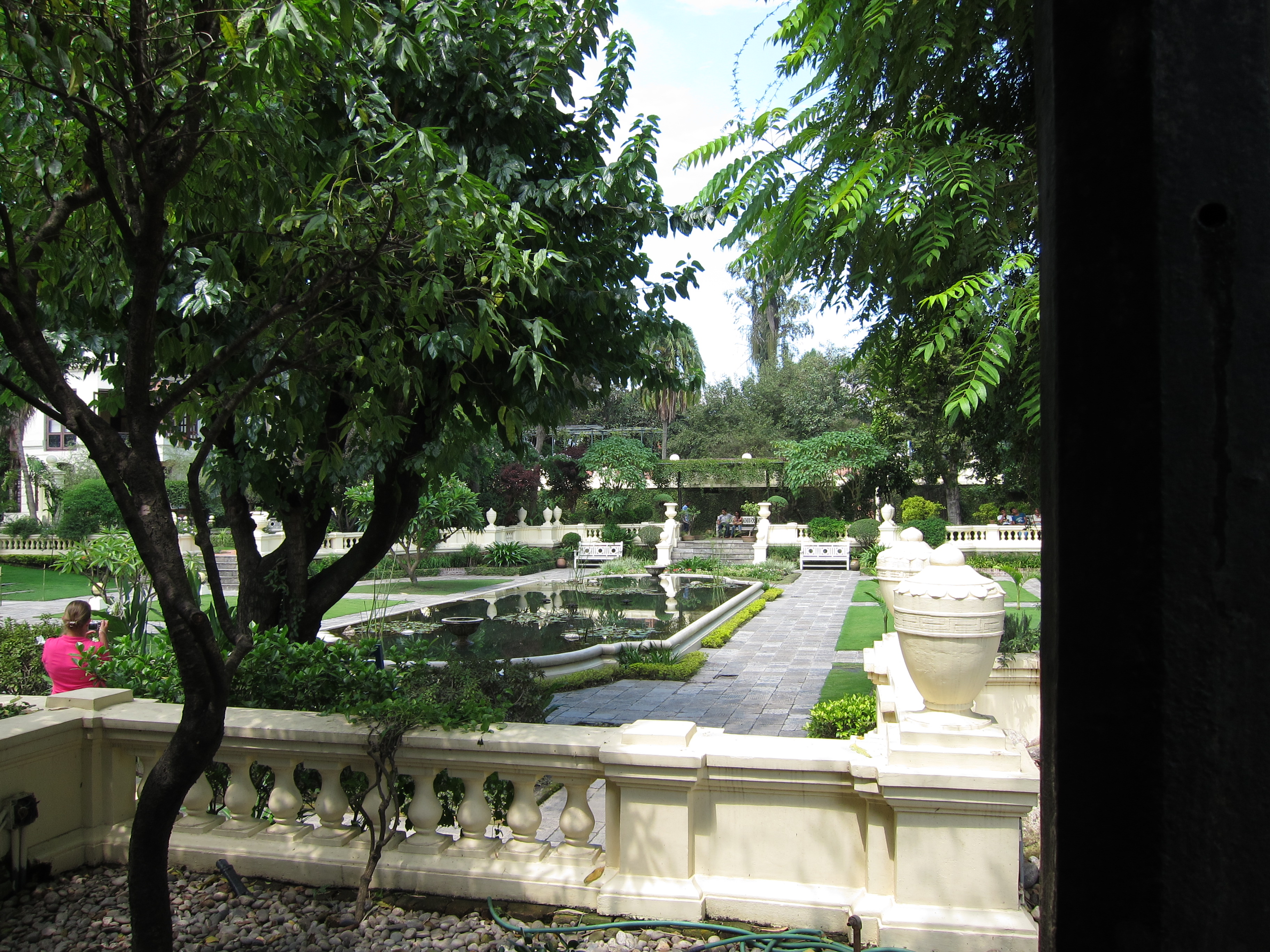
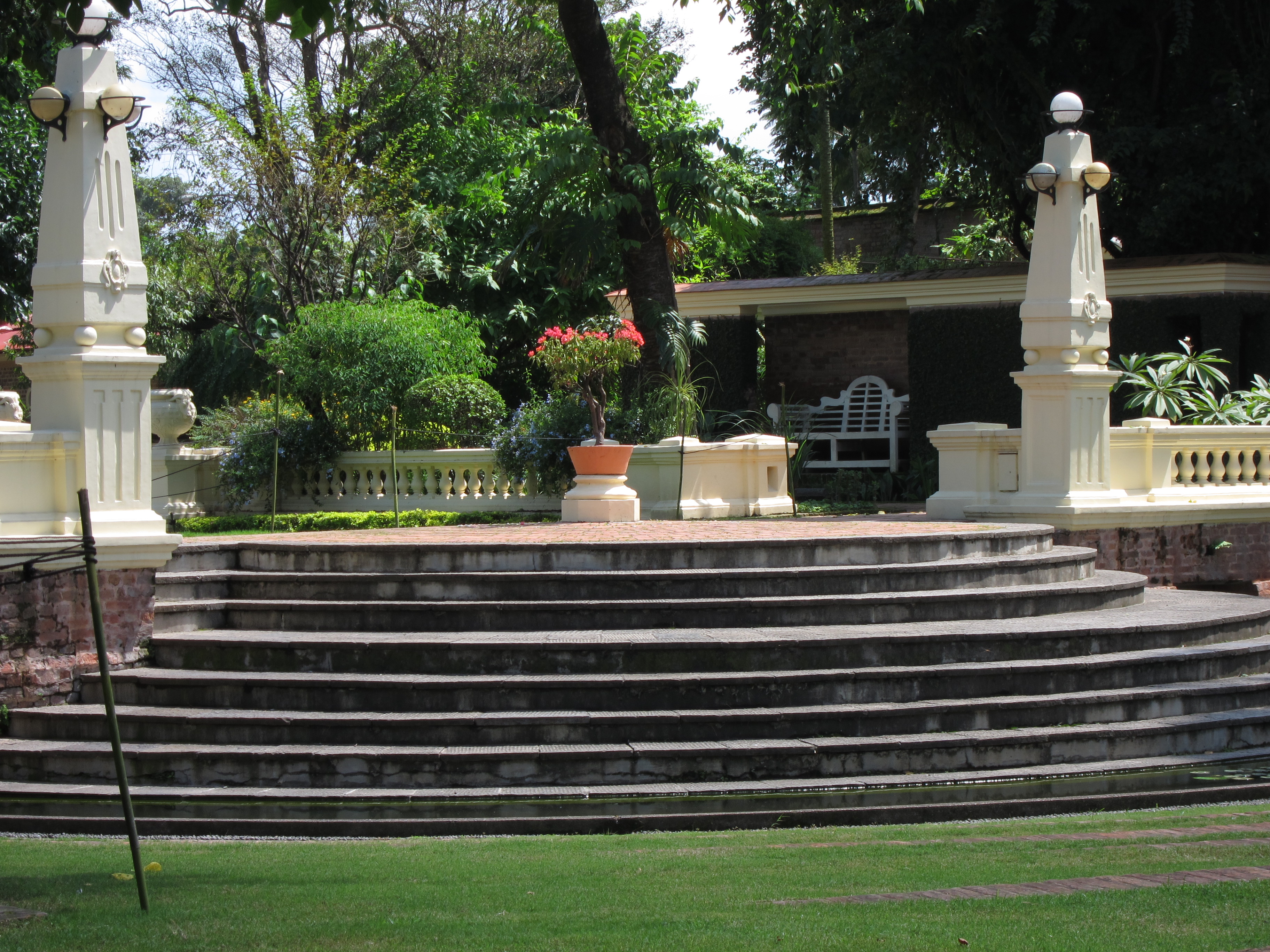
Today I had a mediocre breakfast at the hotel cafe, then went to The Garden of Dreams, conveniently next door to my hotel. The garden was established by a wealthy Nepali in the early 20th century but had fallen into disrepair until an Austrian organization provided the funds to restore it. There was a very overpriced restaurant on site, which I avoided, but I enjoyed strolling through the well manicured garden while taking a few photos. It was a reasonably clear day so I got some good shots. I viewed a small indoor exhibit that explained the origins and history of the garden along with “before and after” photos documenting the restoration.IMG_2359IMG_2358

After sitting outside on a bench for a while I got a little bored so I decided to walk to Swayambunath. It took me about a half hour to get there, and despite the aforementioned traffic challenges I was happy to get out of the touristy areas and witness the more mundane aspects of Nepali life. On my way there was a terrible bottleneck where a street was blocked off, apparently due to a recent fire.

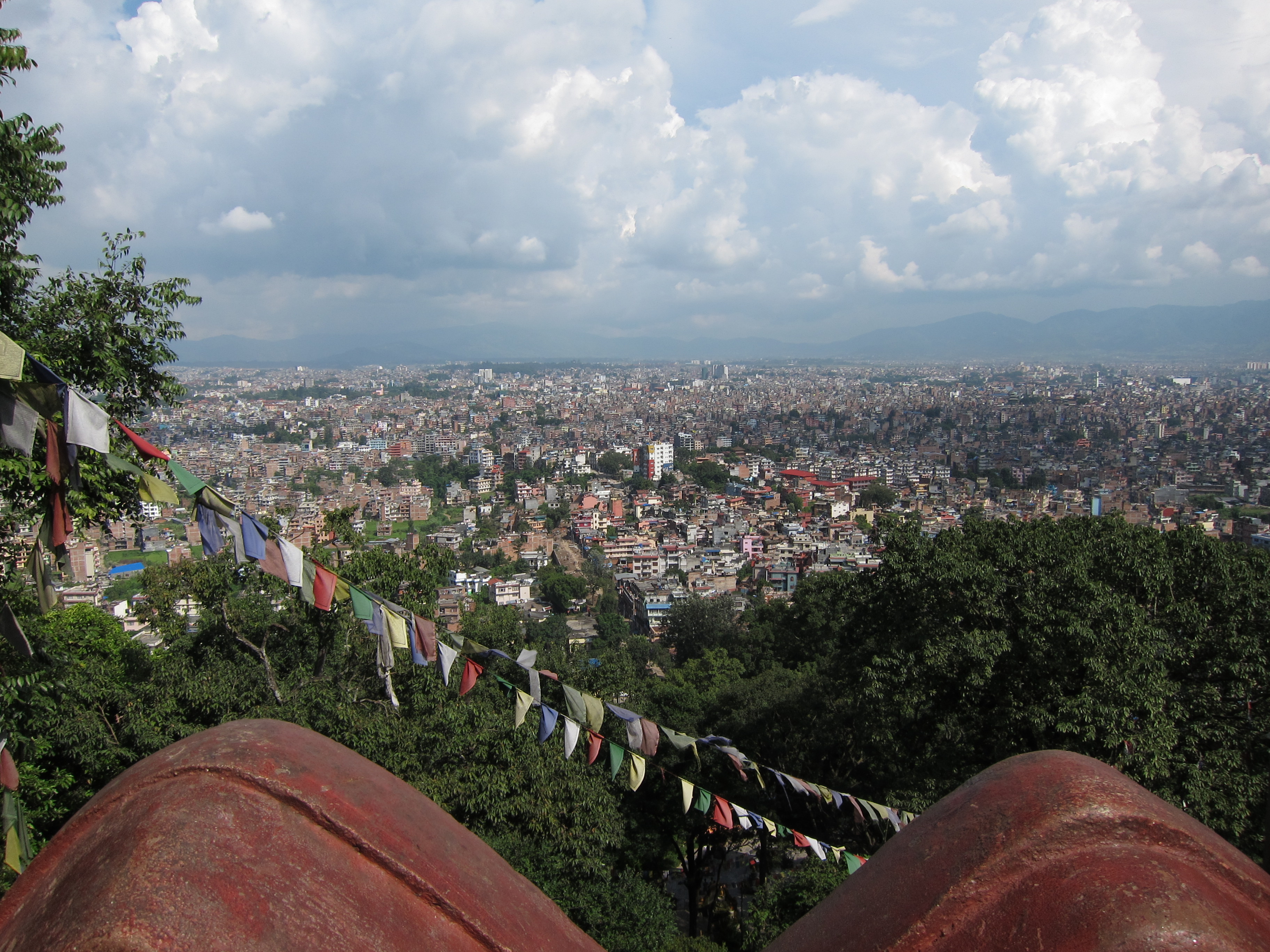
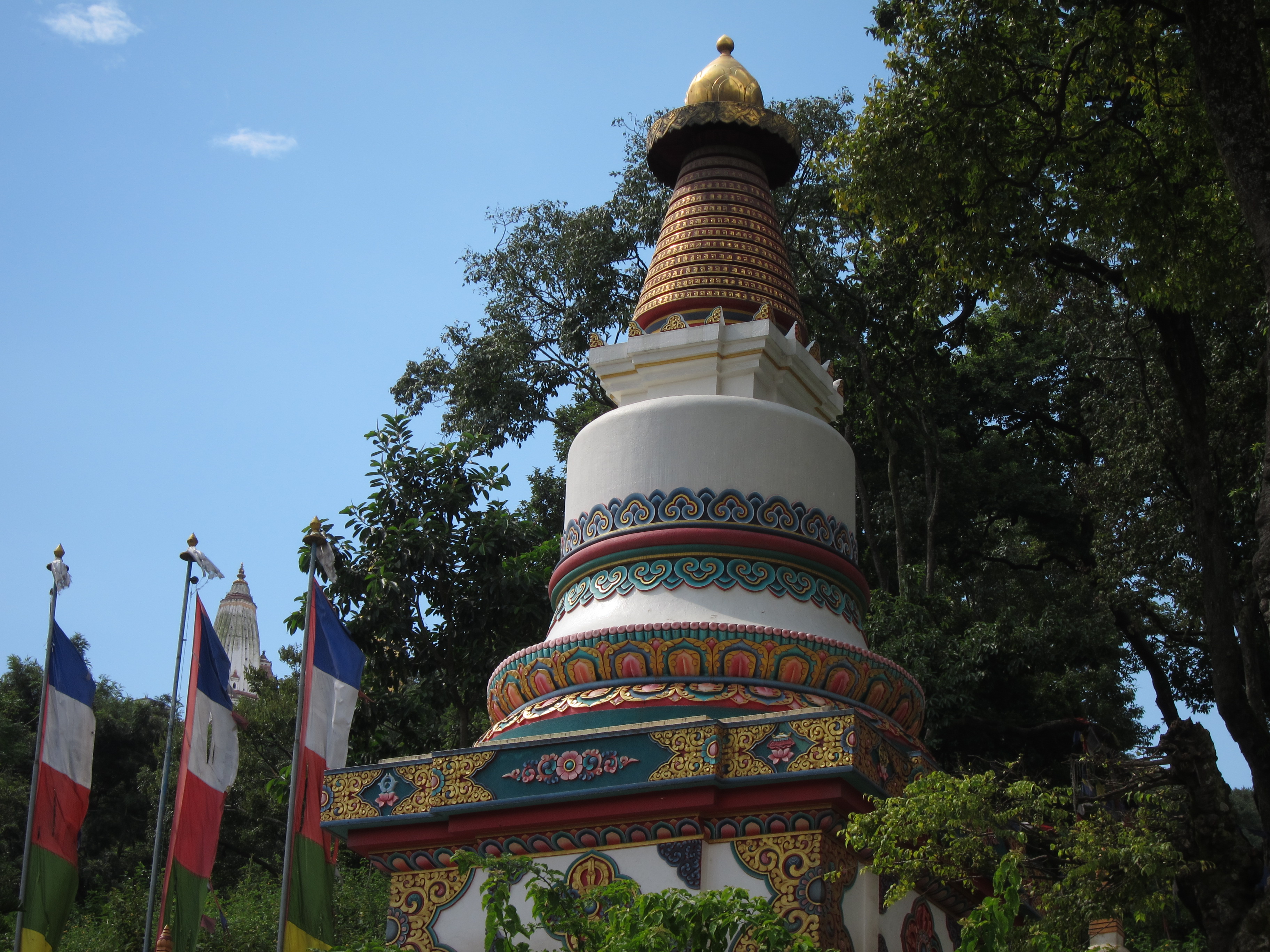
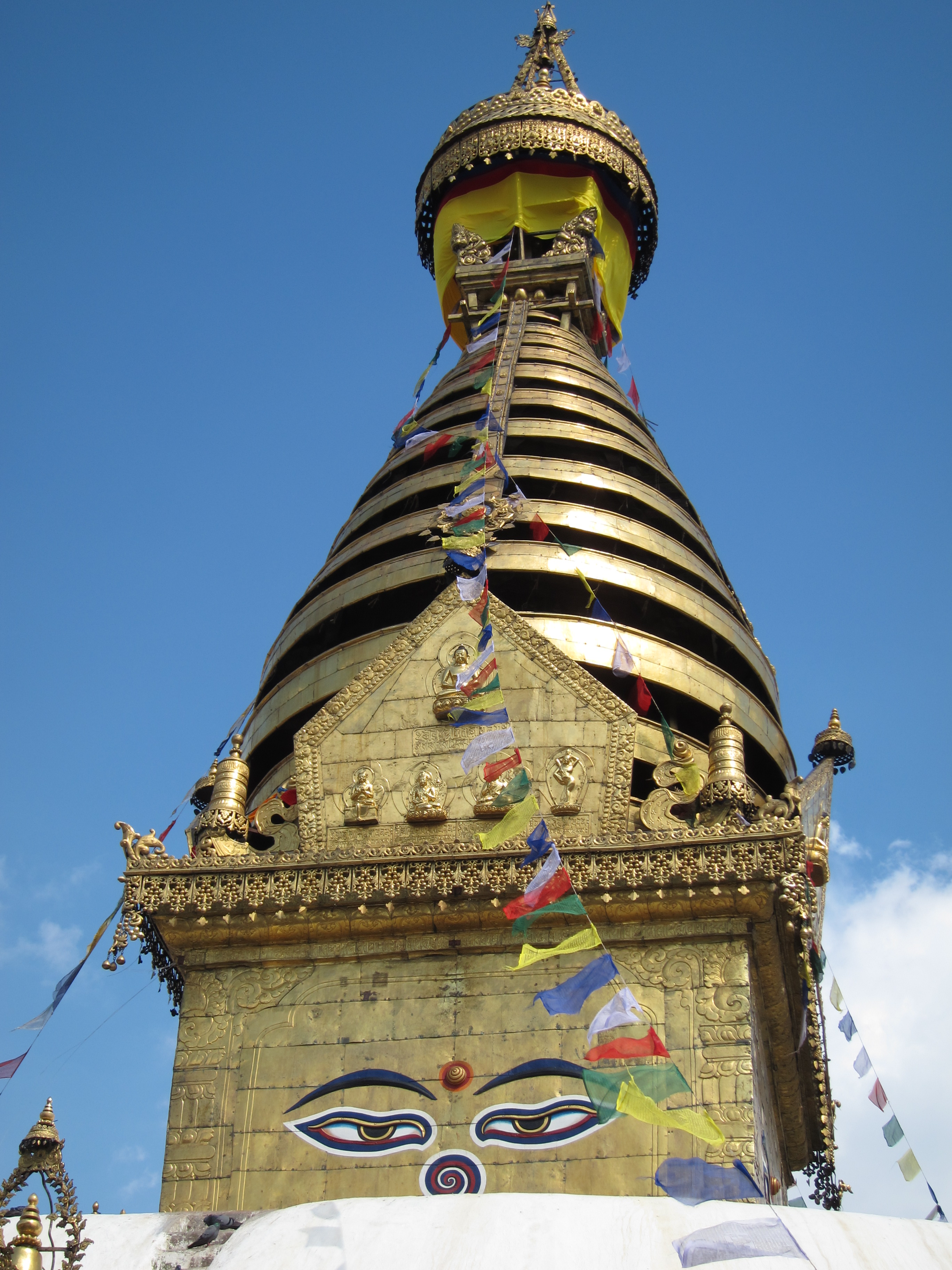
Swayambunath is on a hill overlooking Kathmandu. It has a large stupa, some architecturally interesting small buildings, and the usual souvenir shops and restaurants. After strolling around the stupa and taking a few photos I had a glass of papaya juice at a rooftop restaurant. There was little else to do there so I made my way back to Thamel.

IMG_2376

View of Kathmandu from Swayambunath

IMG_2367

Stupa Near Entrance to Swayambunath

IMG_2370

Climbing the Steps to Swayambunath

IMG_2371IMG_2374IMG_2375

Once back in Thamel I picked up a Nepali SIM card. The young lady at the NCell counter spoke very fluent English, but somehow managed to confuse me at times. She pointed out the basic plan of 500 minutes of local network voice, 500 minutes international long-distance, and 500 MB of data. Then she said, “Do you want only voice or data too?” I asked if there were a plan for just voice (since I could probably just use WiFi for data most of the time), and she said, “No, you have to purchase the whole package.” After completing some documentation and taking a copy of my passport, she again asked, “Do you need data or just voice?”; I said, “You told me I had to buy the whole package, right?”; And she said, “That is correct.” (The only explanation I could surmise for her inquiries about voice only or voice + data, was that once the SIM card was installed, she had to go into the Android settings to add an IP address so that the data plan would be operational).

Before dinner I continued to read in an e-book that I had checked out from the Brooklyn Public Library, The Springs of Namje: A Ten-Year Journey From the Villages of Nepal to the Halls of Congress, by a young returned U.S. Peace Corps volunteer named Rajeev Goyal. While the book did recount the recent political history of Nepal, I mostly found it to be an introspective reflection on the social and cultural implications of small-scale development projects and other economic factors. He explores the latter in his evaluation of the work of large, well-intentioned international development organizations with little knowledge of grass-roots issues affecting the rural, agrarian Nepalis, as well as the interference caused by land speculators focused on short-term personal economic gain at the expense of long-term sustainability.

At the Revolution Cafe yesterday, the young waiter told me about their live “fusion” music performances every Friday evening. I decided to stop by to check it out, and I was not disappointed. The group consisted of a dexterous guitar player, a very rhythmically talented tabla player, and a flutist (playing a wooden Nepali-style flute). They were young but extremely talented and technically skilled, and they were cohesive yet fluid in their interactions as a group. The music was melodious, meandering at times into improvisational tangents, and there was one tabla-driven interlude that I thought was particularly impressive.

Standard
Uncategorized

Thu 18 Sep 2014

My first full day in Nepal! I got up early and headed out to breakfast at the Fire and Ice Cafe across the main street from the alley where my hotel was situated. I then spent the better part of the day following my Lonely Planet guidebook’s walking tours of the Durbar Square and Old Town areas. I lost my way a few times but managed to get back to familiar environs easily.

I saw very few other tourists along the way and I got a chance to see ordinary Nepalis going about their daily routines. The traffic was challenging — the roads really no more than alleys, semi-paved with flat stones and sometimes with asphalt or concrete. Sidewalks were nonexistent. Through these narrow arteries coursed all kinds of vehicles: mostly motorbikes but also many cars, some bicycles, the occasional cycle rickshaw, and, unbelievably, large trucks. Congestion was rampant. We multitudes on foot threaded our way around, between, alongside, and (daringly) straight through the paths of those on wheels.

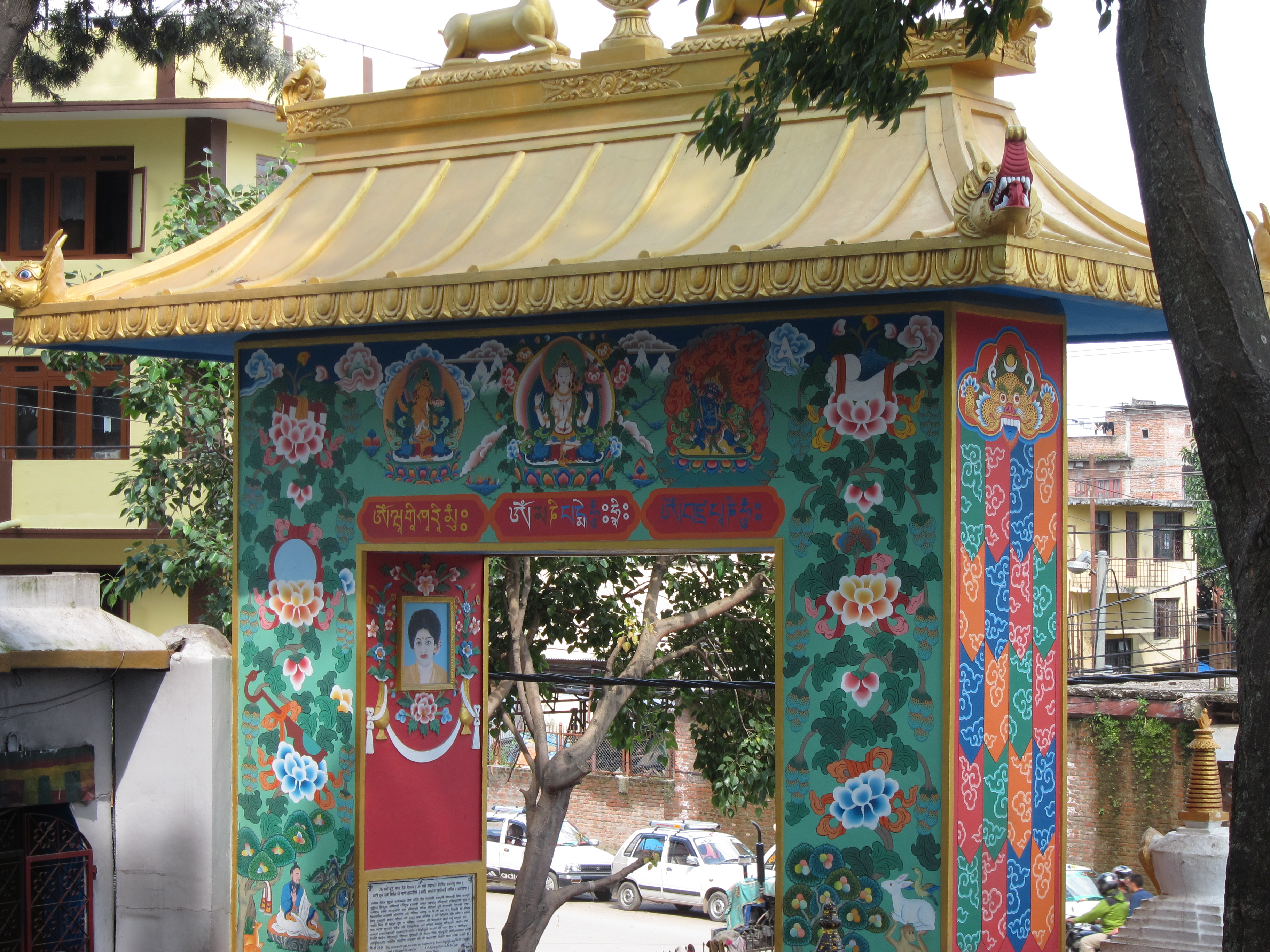
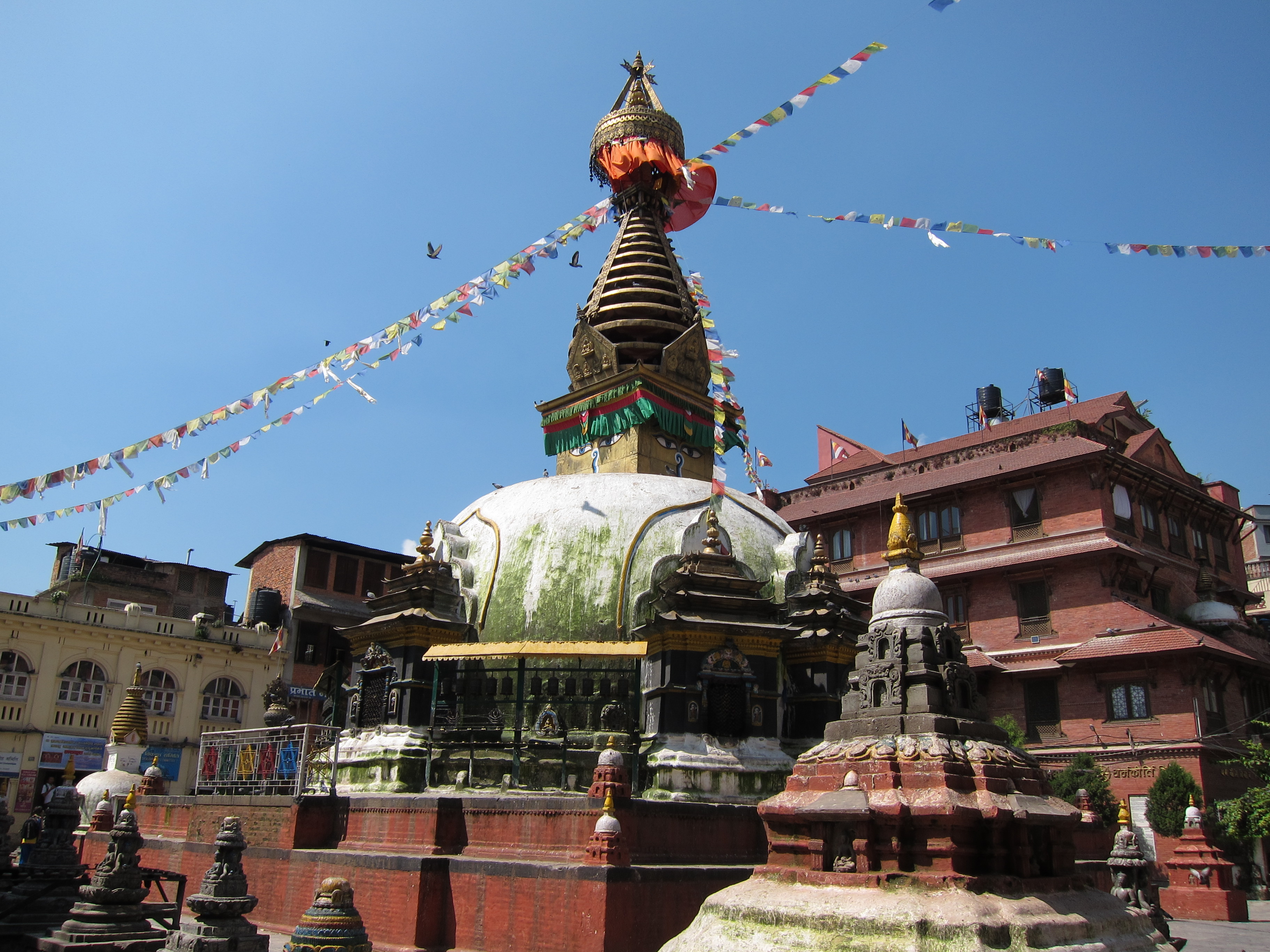
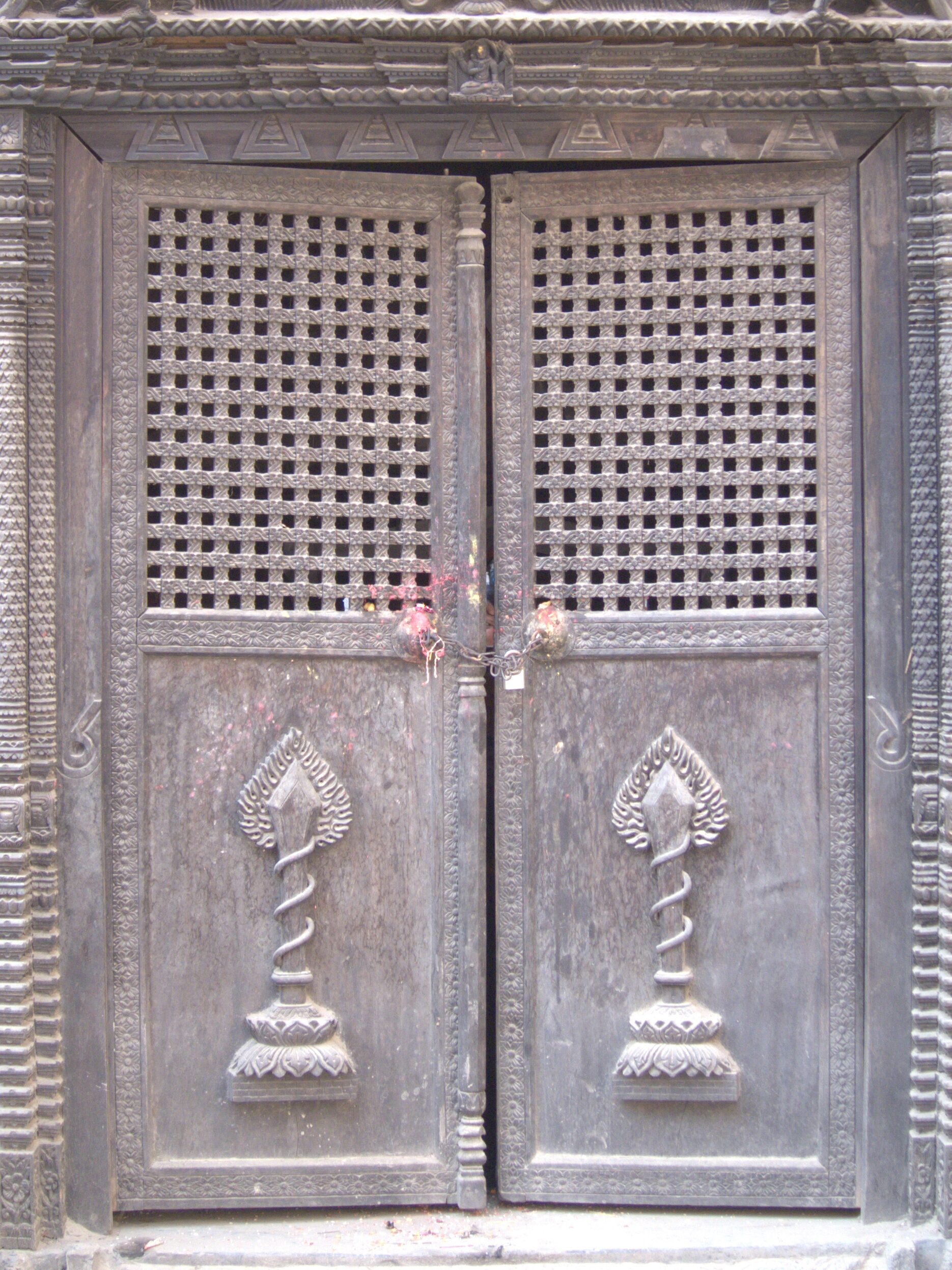
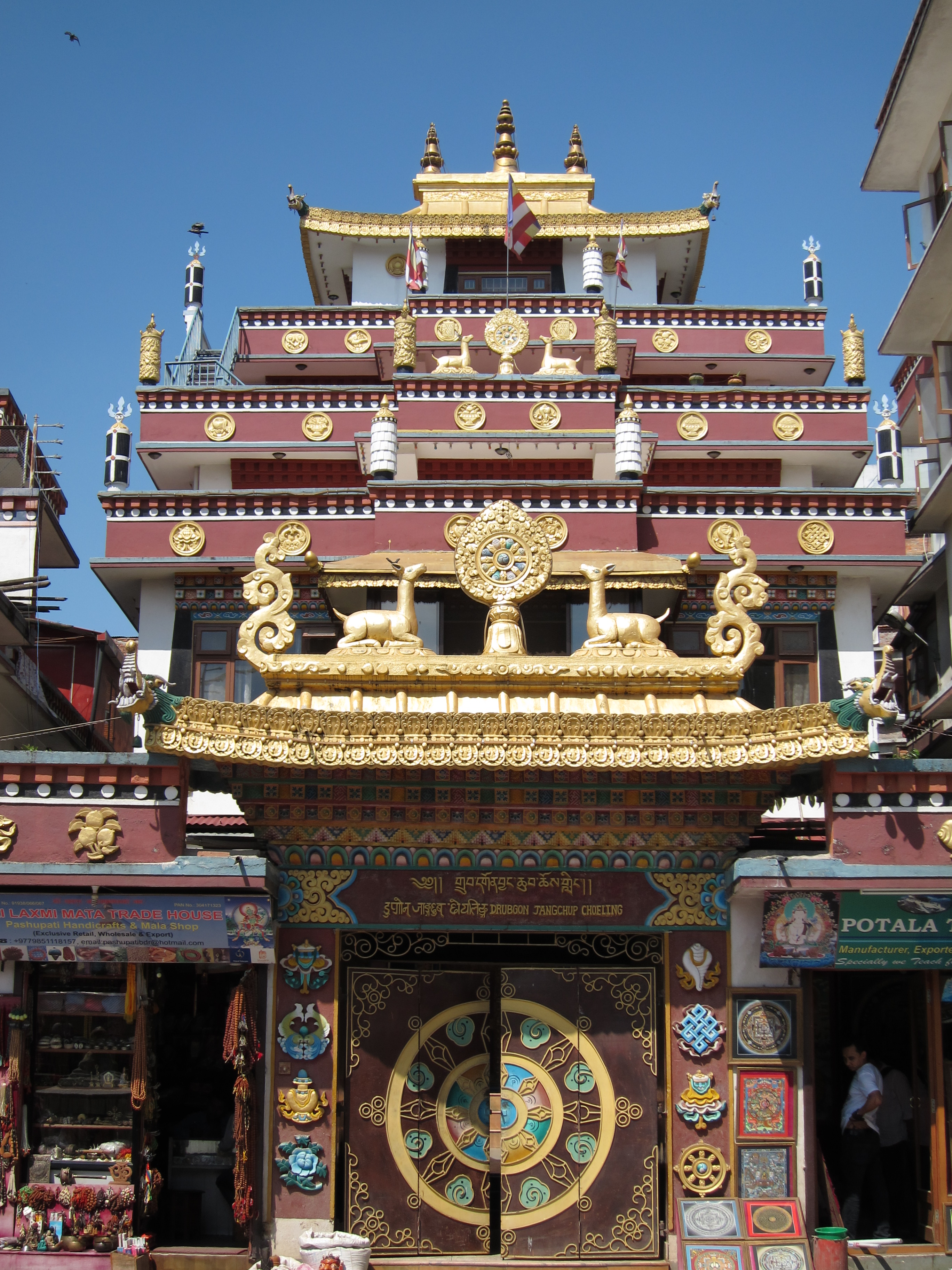
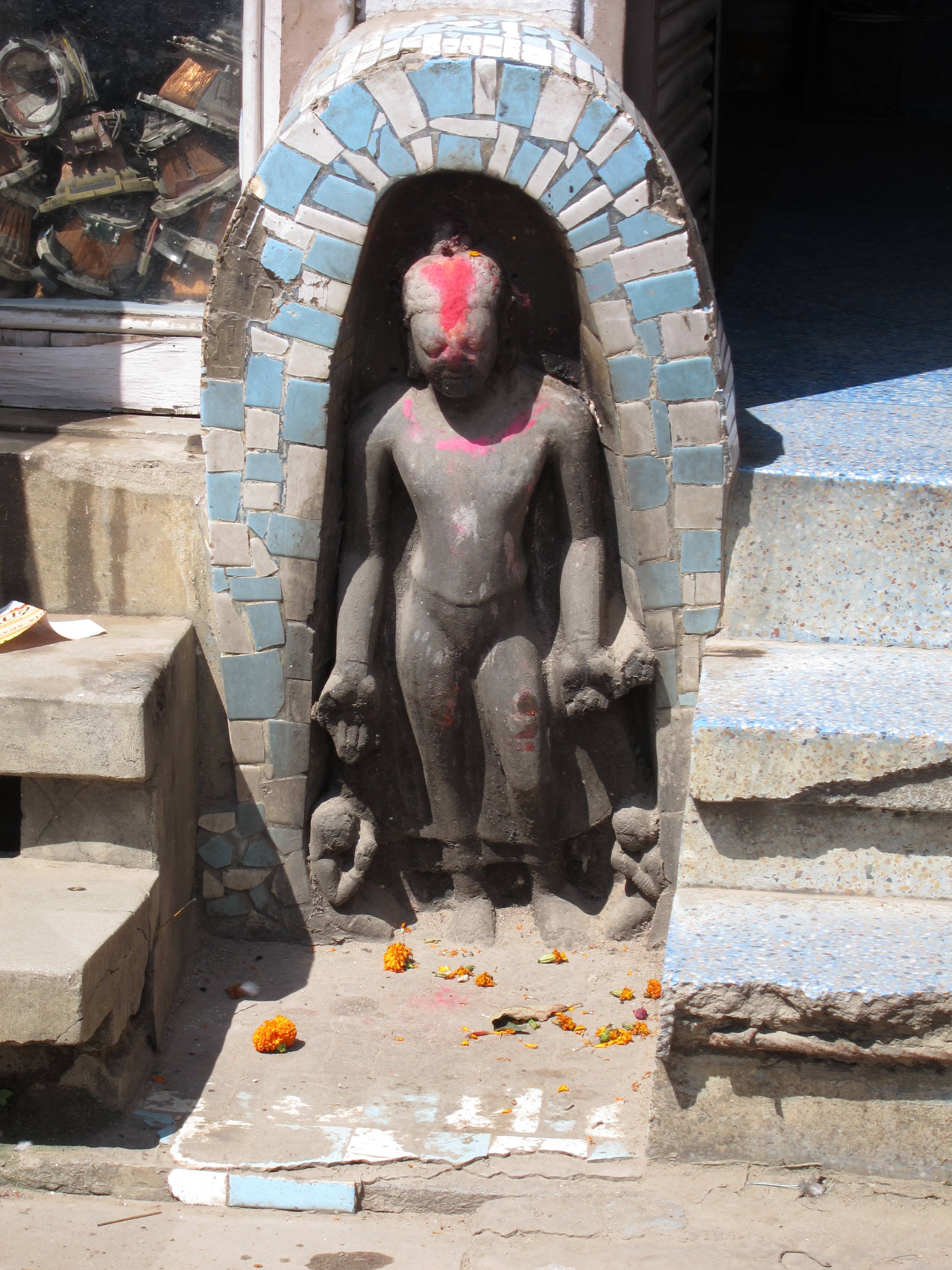
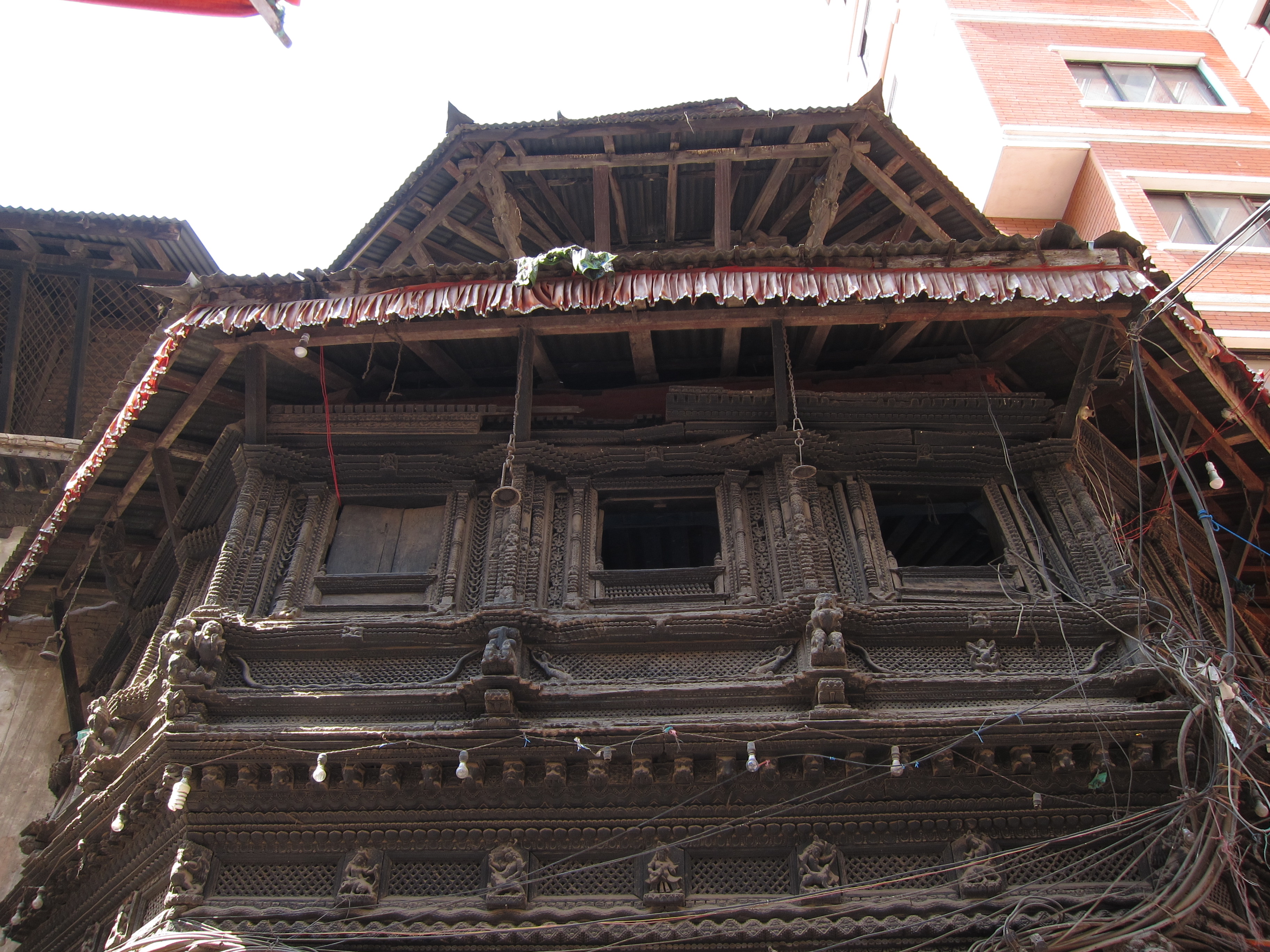
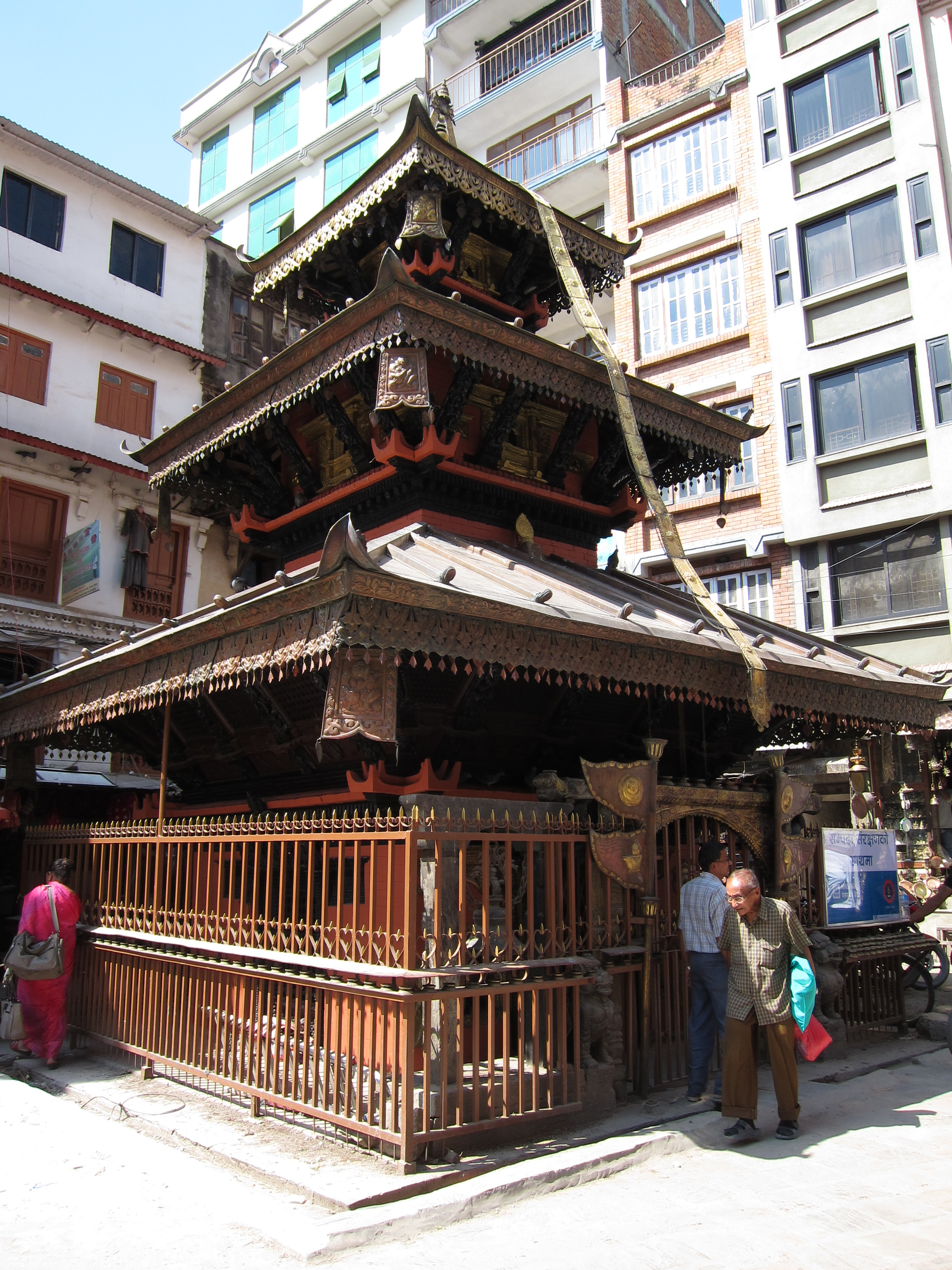
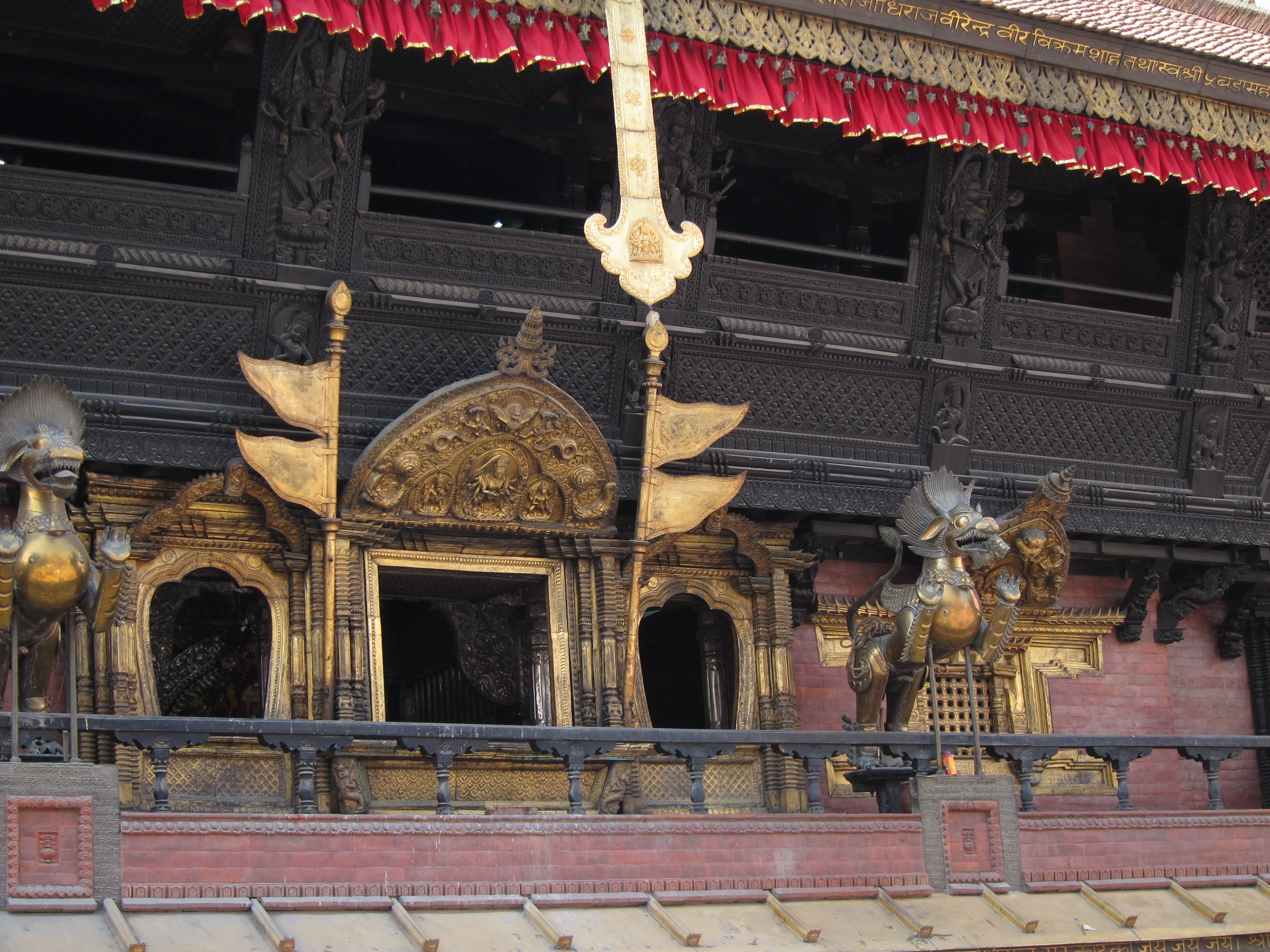
As I walked I took note of the ancient stupas, temples, and various Hindu and Buddhist sculptures around which the city’s buildings had grown like large tree roots grow around boulders. Many of the buildings were decorated with intricately detailed wood trimmings. There was a small 500-year-old statue of Vishnu nestled between the entrances of two shops. The statue was so small I would have overlooked it had my guidebook not made mention of it. The locals were not oblivious to this sacred icon in their midst — it was adorned with fresh flowers and vermilion-colored powder.

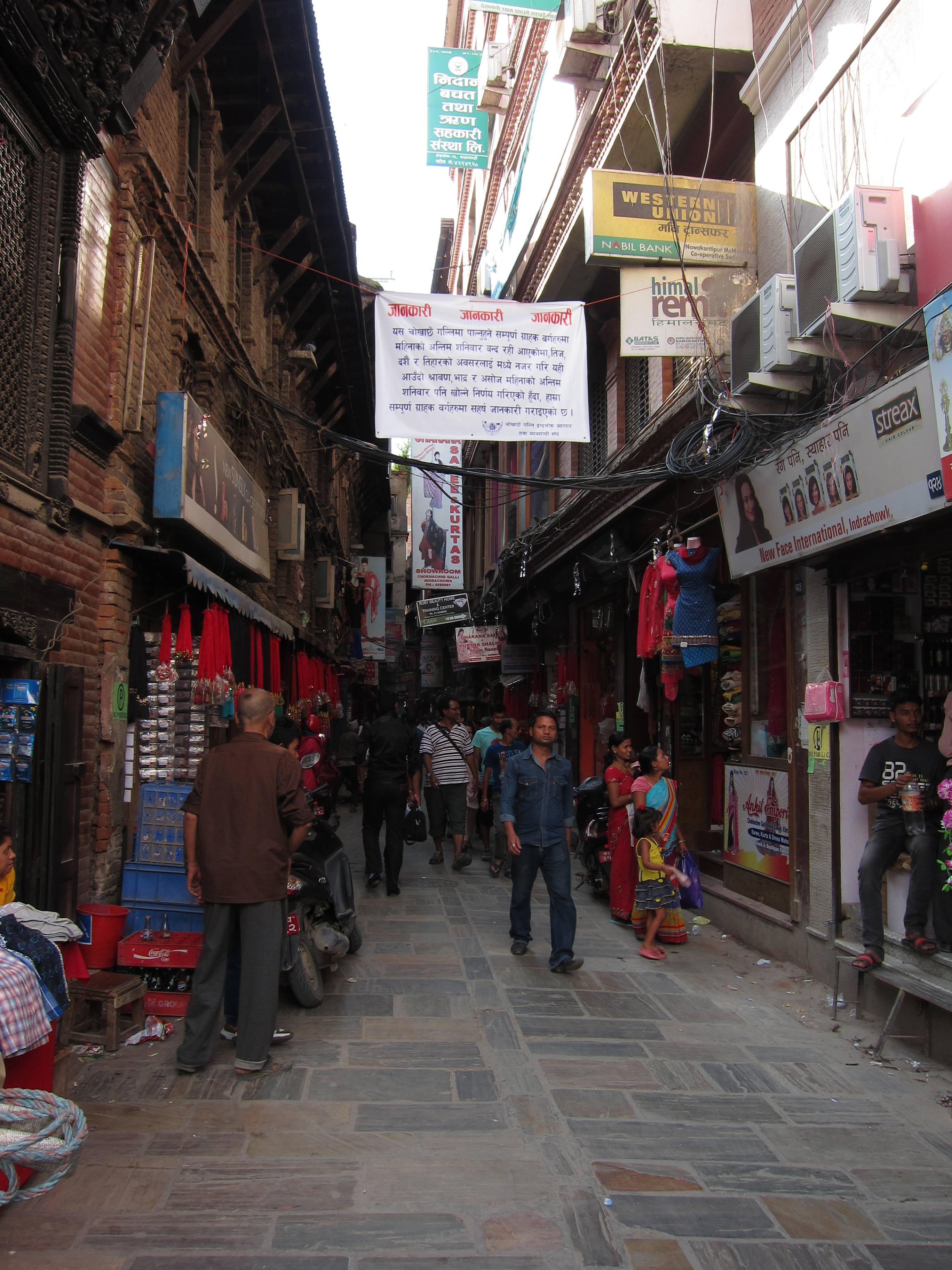
My favorite spot in my meanderings turned out to be a narrow, cobbled alley that snaked between tall houses, creating a cool quiet path away from the nearby noise and bustle of Indra Chowk. Small shops selling brass-ware, incense, embroidered clothing and trinkets lined this alley. I stopped for a soda at a tiny storefront shop, where I sat on a small stool perched on the slightly elevated floor of the shop, looking out into the alley, while the shop’s middle-aged proprietress curiously gazed at me.

After resuming my walk and finally returning to the center of Thamel, I ducked into a cafe and had some tea and steamed Tibetan dumplings called momos. Similar to my hotel the Revolution Cafe was down another alley off the main street, and it had a small garden in the back. As it turned out, I would return a few more times to this Kathmandu hipster joint, prior to leaving the city.

IMG_2332

15th Century Stupa at Thahiti Tole, Kathmandu

IMG_2353

Cool Alley off Indra Chowk

WindowIMG_2335IMG_2343IMG_2345IMG_2346IMG_2348IMG_2351

Standard