Uncategorized

Tue 7 Oct 2014

This charming young lady was waiting tables at a cafe.   She is also in college and I hope she will have the chance to continue studying.

This charming young lady was waiting tables at a Pokhara cafe. She is also in college and I hope she will have the chance to continue studying.

Back in Pokhara, I explored my options as to how I would spend my last week in Nepal. While several people had recommended I go to Lumbini (Buddha’s birthplace) I decided I wasn’t up for the ten-hour bus ride there. I decided I would spend a few more days in Pokhara, going through my photos and catching up on my blog, then spend one night in nearby Sarangkot. Finally I would make my way back to Kathmandu, stopping on the way for a few days in Bandipur.

A few weeks back I had met a young girl who served me at a local Pokhara restaurant — she looked no more than 15 years old. She appeared shy and not completely confident of herself – she said she was new. However she was very attentive and was trying very hard, and when her manager asked me if she was doing well, I told him honestly that she was doing a great job. When I paid the bill I gave a small tip which she was reluctant to take, smiling shyly and saying, “Oh no sir, it is OK!” Finally she took the money after her manager nodded. Was she as young as she looked? Was she in school? I was curious about her story.

Today I ended up having lunch at the Newari Cafe where she worked and since it was not busy we chatted for a while. She said she was 17 (older than she looked) and I was glad to know she was in college (11th Standard). She was very fluent in English. I complimented her on her English and encouraged her in her studies. She said she was the eldest of four siblings and that they and their mother had arrived four months ago in Pokhara, to join some other family members. I had assumed she was a Nepali Newari (it was after all the Newari Cafe!) but I learned she was from India — Nagaland to be exact.

India or Nepal, girls face many more challenges than boys, even before they are born. In Nepal, for example, female literacy significantly lags that of males, girls are less likely than boys to be enrolled in school, and girls are more likely than boys to be working at a young age (UNICEF). Nagaland has similar statistics.

I suspect that this young woman can go far if given the opportunity, so let us all wish her well in hopes that she may continue in her studies and reach her potential. (She gave consent for me to take her photo, and I gave her the address of this blog).

Standard
Uncategorized

Mon 6 Oct 2014

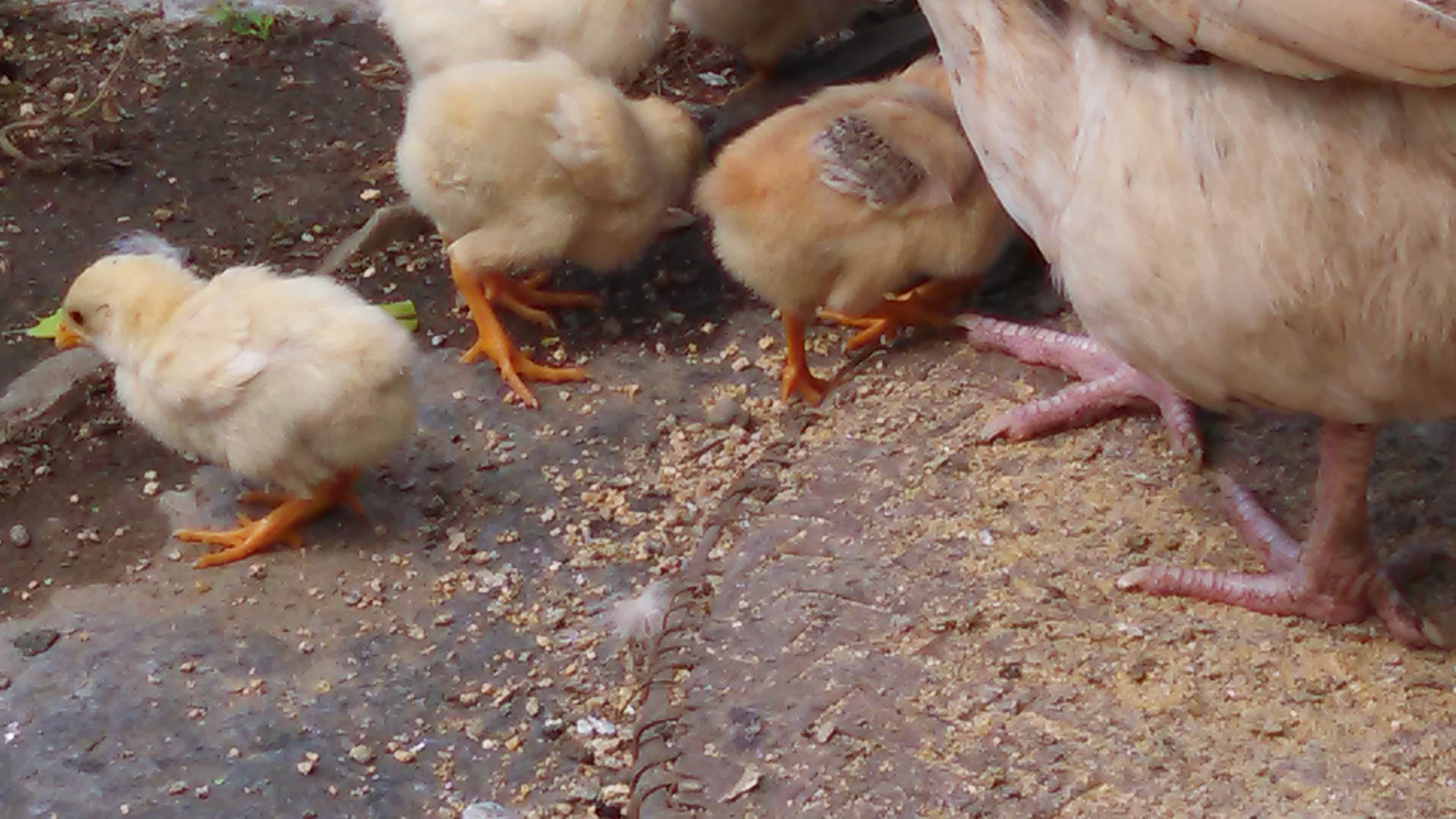
Some Cute Nepali Chicks, Under the Wa

Chicks & Mom, at Magar Family Home

Back to civilization today! We walked for about three hours in the morning today, reaching a tiny village around noon, where we had lunch at a Magar family home.

There was a baby there named “Enji” who was being carried around by an older girl cousin. Enji was very interested in my sunglasses and gazed curiously at me. Eventually we shook hands and did a few “high fives” which she found very exciting. She had six teeth (I counted).

We ended up at a town called Phedi, where a taxi was waiting to take us back to Pokhara. The rest of the day I relaxed, tired from six days of intense physical activity.

IMG_20141006_092353_889

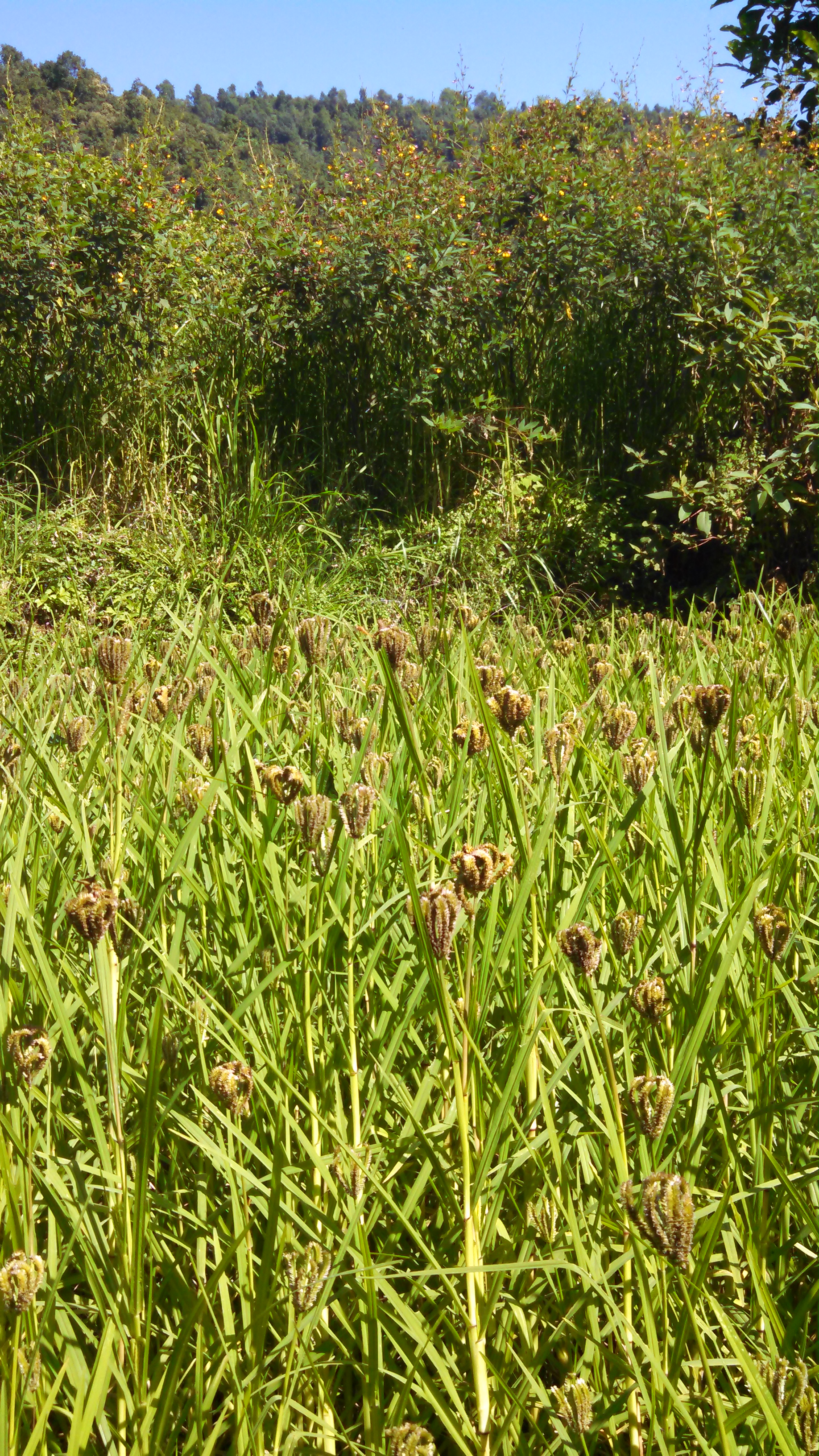
Millet in Foreground, Black Lentils in Background

Millet in Foreground, Black Lentils in Background

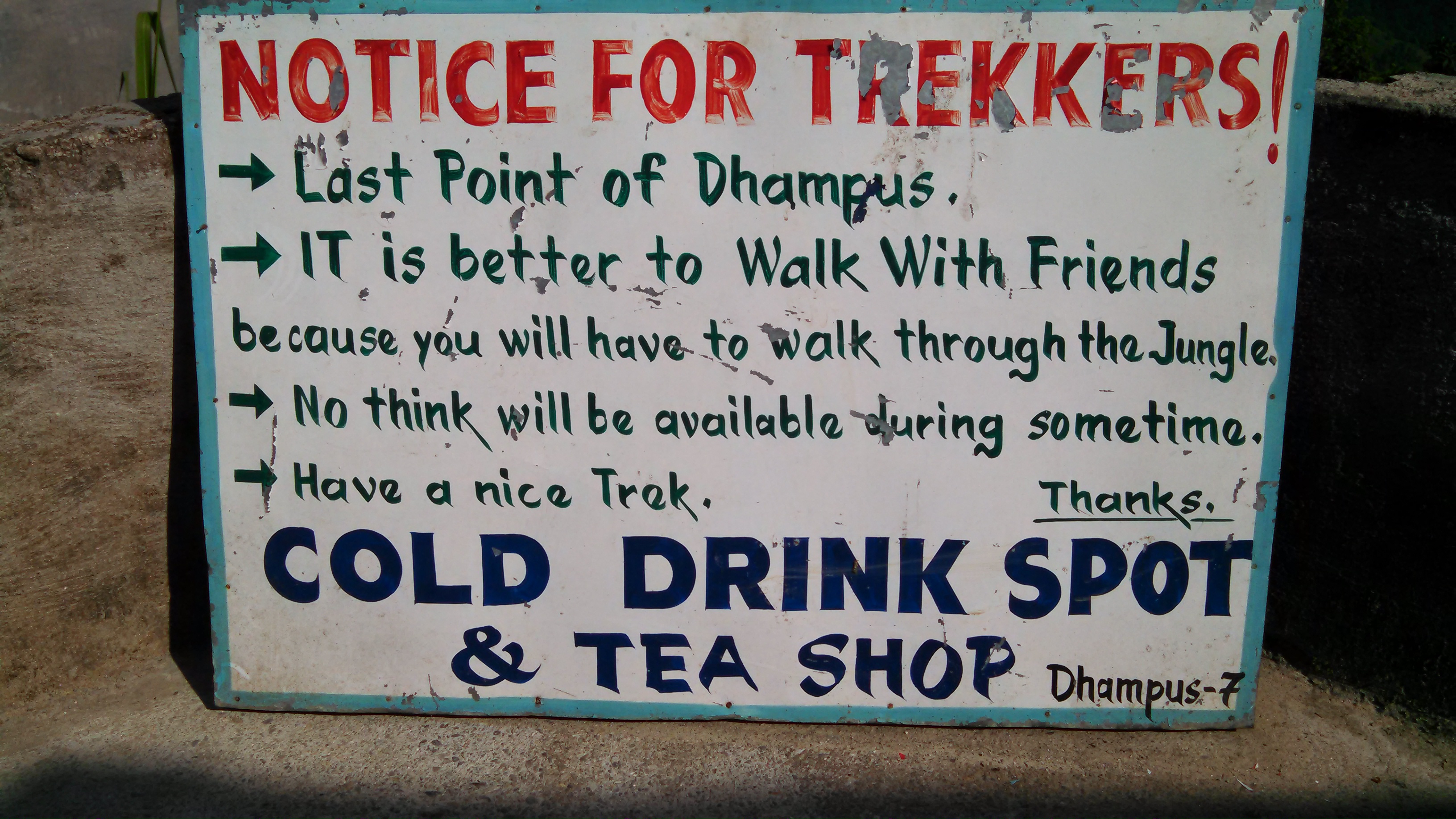
Sometimes we think too much. So I was very relieved to see this sign stating, "No think will be available for some time,"!!

Sometimes we think too much. Imagine my relief when I saw this sign stating, “No think will be available during some time,”!!

Standard
Uncategorized

Sun 5 Oct 2014

Beans Drying in the Sun

Beans Drying in the Sun

The weather got warmer as we descended. I enjoyed passing through the villages, where we would stop for tea, lunch, or to stay for the night. It seemed that the villages were quite self-sufficient in many ways.

As I mentioned earlier, they got their water from the mountain rivers and streams, and their power from hydroelectricity. (In fact, while Nepal’s two largest cities, Kathmandu and Pokhara, experienced daily power cuts — called “load shedding”– many of the villages boasted of “24 hour power”).

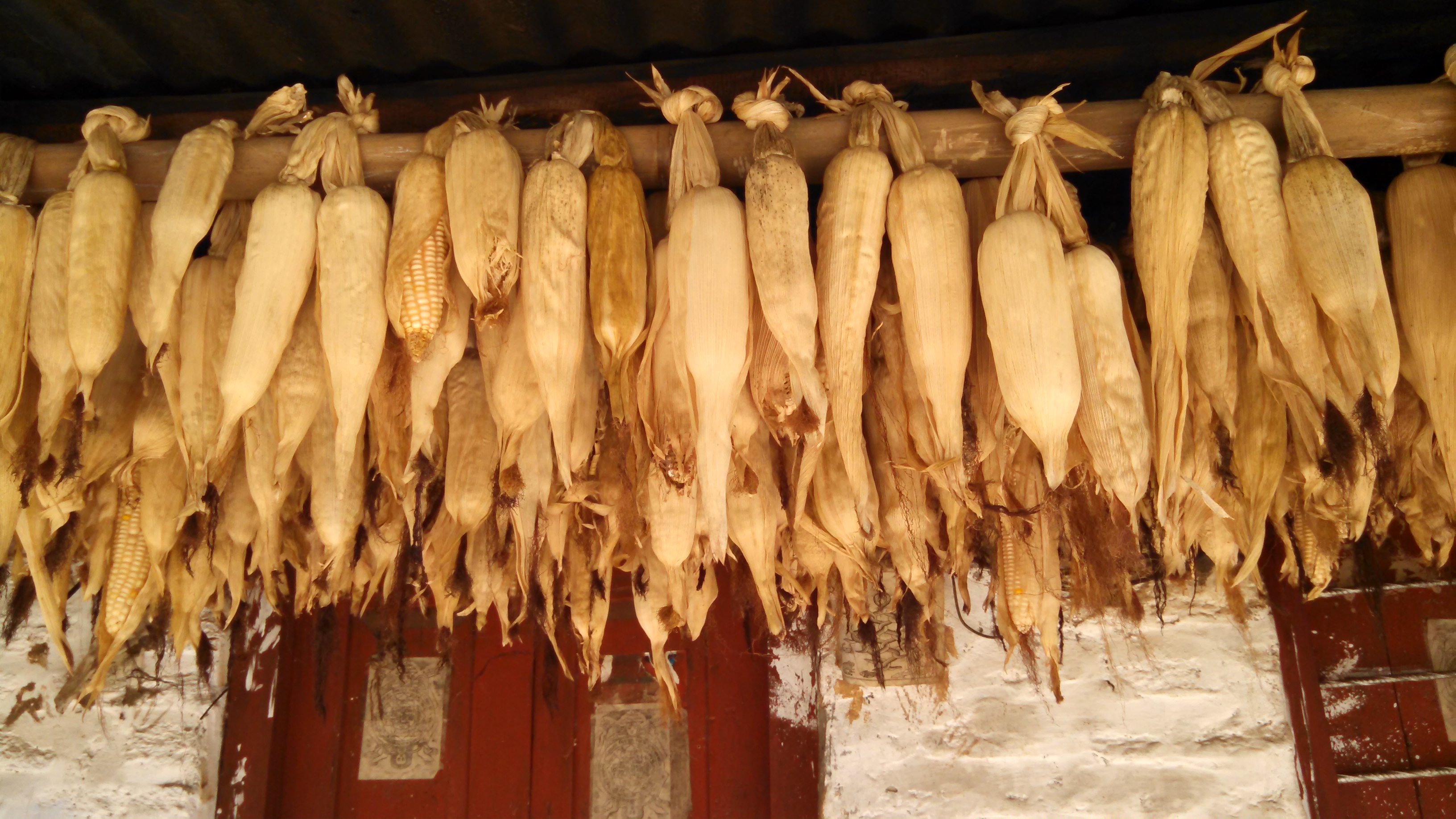
They grew rice, millet, corn, beans and vegetables like mustard greens and cabbage. They grew some lentils (for the Nepali staple of dal bhat) but Mane said most of the lentils grown in Nepal came from the southern Terai region. They also kept chickens, buffaloes and cows. And of course, these villages on the trekking routes generated a significant amount of revenue from providing food, lodging and other amenities to trekkers.

Terraced Rice Paddies

Terraced Rice Paddies

"24 Hour Dal Bhat Power" -- a slogan I saw on t-shirts here.

“24 Hour Dal Bhat Power” — a slogan I saw on t-shirts here.

From the beginning of the trek, I found one of the biggest challenges to be Dodging Donkey Dung. The donkeys on the trails had managed to spread their “fertilizer” left, right and center, so that it was impossible to walk a straight line on certain portions of the trail. Why were there so many donkeys on these trails?!

Beast of Burden

Beast of Burden

Only later did I become aware that it was because of the donkeys (and horses and mules too) that I was able to enjoy certain amenities at the restaurants and lodges. Since in the mountainous terrain wheeled vehicles were of no use (and indeed there were none), everything had to be transported by people or beasts. So these animals made their living transporting lentils and potatoes, toilet paper and soda, soap and towels, biscuits and chocolate, batteries and bulbs, and so on. I felt more compassionate towards the donkeys (and their dung too) once I developed this awareness.

Pepper Growing at a Village Guesthouse

Pepper Growing at a Village Guesthouse

Red Hot Chili Peppers, Sunbathing.

Red Hot Chili Peppers, Sunbathing.

Standard
Uncategorized

Sat 4 Oct 2014

My Competent, Professional & Protective Guide, Mr. Mane Gurung

My Competent, Professional & Protective Guide, Mr. Mane Gurung

We continued along our trekking route, and at some point Heebeom and her guide veered off in a different direction, pursuing the ABC trek route. I learned more about Mane as we spent more time together on the trail.

He was just a few years younger than I, but our paths in life were very different. His mother died when he was five, followed by his father several years later. Mane was raised by relatives but they had no money to send him to school, so he received no formal education. When he was old enough to accept responsibility, he tended the cows in his village. Then, when he was in his late teens, some friends with more education and connections helped him get a job as a porter serving international tourists on various Himalayan trekking routes.

He worked as a porter for about five years, at times carrying over 45 kg (100 pounds) over the steep mountain trails, for several hours each day. He eventually became certified as a guide, and had been working in this capacity for 22 years. During the worst of the Maoist conflict, for six years he worked as a cook on trekking expeditions in Ladakh, India, for several months of each year.

With no family support to rely on, in a society in which arranged marriages were the norm, he found his own wife and married her. Since he was Gurung and she was from the Mustang area, they spoke different native languages, but as they both spoke Nepali, that was their common language.

It was clear to me that Mane couldn’t read in any language, though he made efforts to feign literacy. He never directly admitted it, but one time I overheard a laborious phone conversation he was having with a colleague, in which he was trying to convey a telephone number and other details, after which he said, “Very difficult — he cannot read either.”

He and his wife had three children: a girl, 19, and two boys, 17 and 13. He explained that he had saved no money over the years, as he spent every extra rupee on his children’s education, including two years of English-medium secondary education in a boarding school for his two older children. He did this because, “No read — very difficult.”

He reported all his children were fluent and literate in Nepali, Hindi, and English; that his daughter had completed two years of post-secondary education and he hoped his sons would do the same.

So despite having no formal education and not being literate, by the most important measures this was a very successful man. I sincerely told him I was impressed with his accomplishments and in his modest way he acknowledged his satisfaction with what he had accomplished thus far.

A basketball court at 3000 meters. Could this be the highest court in the land? *Note that they are actually playing football (soccer)!

A basketball court at 3000 meters. Could this be the highest court in the land? *Note that they are actually playing football (soccer)!

Standard
Uncategorized

Fri 3 Oct 2014

Dawn View from Poon Hill, Ghorepani

Dawn View from Poon Hill, Ghorepani

“Sir! Sir! It is time!” Mane’s vigorous door-knocking and urgent cries roused me from a deep sleep. Bracing myself against the cold night I had pulled the covers over my head and only now I reluctantly peeked out into the…complete darkness. Was it such a big deal to see the sunrise? Doesn’t it happen daily?!” Well, I acknowledged to myself that I probably would regret not going, so I slowly got out of bed, pulled on my boots and rubbed my eyes.

“Lady is waiting!” What on earth could Mane be talking about? If there were any phrase to get a man moving, this would be it. But one of the huge benefits of traveling alone was to avoid this very scenario. I thought he must be saying this just to get me to move faster, but when I got downstairs Heebeom was ready to go.

Indeed, despite being on a 10 day trek where there would be no heat or hot water for nights on end, where the accomodations were literally wood shacks with cardboard-thin walls between the rooms, where there were no commodes, only squat toilets…she was still very clearly a “lady.” I had been impressed with how light she was traveling (one small backpack) until I noticed that her guide seemed to be carrying a larger load than the others, including a very girly pale pink pack and a duffel that had “South Korea” written in English across its side. When she asked anyone to take a photo of her, the shutter button could not be pressed until she had opened her compact to peer into her mirror, rearrange her hair and touch up her makeup. Before sitting down at a rest stop on the trail she would place a flowery seat cushion on the flat rocks. And she had furry striped socks and house slippers to wear in the evening. I found all this very amusing.

Anyway, along with the rest of the sunrise crowd we climbed up the steep hillside, reaching the peak in about an hour and a half. Now I was grateful to Mane for insisting on an early start, because we were some of the first ones there, and had our pick of the prime spots to get the best views. (A half hour later the area was crammed with tourists from around the globe jostling each other with their huge DSLR cameras, trying to get that perfect sunrise shot).

IMG_2532

We returned to the guest house around 7:00 a.m. and had a good breakfast, to prepare for the long trek to the next town where we would break for the night.

Sunrise

Sunrise

Still Sunrise!

Still Sunrise!

IMG_2603

Standard
Uncategorized

Thu 2 Oct 2014

IMG_2505

There is Water Everywhere!

We continued trekking along the route to Ghorepani. Heebeom, my new Korean friend, and her guide were heading the same direction so she and I ended up chatting a bit more. However communication was difficult as her English was not as good as I had initially thought. At one point she said, “Sorry — my English very small!” I told her my Korean was even smaller than her English. The only words I knew were “Kamsamanida” (thank you), “Oppa/Unni” (big brother/big sister) and “Kimchi” (kimchi!). She giggled some more, then said , “Bibimbap!” Still, I was able to learn that she was almost 40, worked as an accounting manager in Seoul, and had saved up two years’ of her vacation days to enjoy a 20 day tour of Nepal, including her trek to the Annapurna Base Camp.

The Trekkers & Their Guides

The Trekkers & Their Guides

We continued to climb, up, up and further up. The trails were well established and often paved with flat stones quarried from the hillsides. These same stones had been embedded into the steeper parts of the trails, creating a seemingly endless spiral stone staircase that we would climb for hours at a time, with frequent rest stops and water breaks.

Climbing Higher and Higher...

Climbing Higher and Higher…

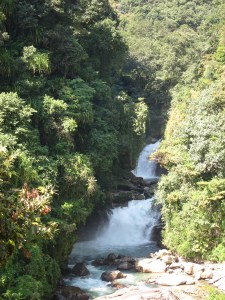
A few more words about water in Nepal. Water is both abundant and scarce here. I witnessed this abundance in the torrents of water streaming down the mountains and hills into powerful rivers that often thundered down towering waterfalls. Throughout my trek I could almost always hear water: the trickling of a stream, the distant white noise of a river somewhere, the roar of a nearby waterfall. Several times each day we would cross a bridge over a deep river or walk across the rocks of a shallow stream. This abundance of water combined with the mountainous terrain creates a huge potential for hydroelectric power.

Mini Hydroelectric Installation

Mini Hydroelectric Installation

While water itself is plentiful, oftentimes villagers have to trudge kilometers to reach the nearest stream or river. In the villages we passed through water never seemed to be a problem — it was obtained by diverting it through hoses or pipes from a nearby uphill stream or river. However not all villages shared this luxury, and in the lower hills and valleys with higher population density and increased sources of pollution (industrial as well as human and animal waste), potable water was in short supply.

Water Millhouse

Water Millhouse

Water Mill Grinding Corn (note the corn falling from the funnel onto the grinder)

Water Mill Grinding Corn (note the corn falling from the funnel onto the grinder)

With this in mind I tried to be mindful of my water use, making sure to completely turn off spigots, take shorter showers than usual, and flush minimally and only when absolutely necessary!

IMG_2510

After several hours on the trail we reached Ghorepani where we spent the night. Mane explained to me that in Nepali “ghore” means horse and “pani” means water, so it seemed likely that this village had its origins as a rest and watering spot for horses on the trail. I learned that many villages in the area had “pani” in their name, another reminder of the importance of water. For example a village further down the trail was named “Tadapani”, meaning “far water” — according to Mane, in the early days of the village its residents had to walk a long way to fetch water.

Before dinner I sought to refill my water bottle, and the young man of the house pointed me toward a spigot. He pulled off a hose that was connected to the spout, allowing me to fill my bottle directly from the spigot. When I had filled my bottle halfway, I suddenly heard, “Pani, Pani!” from the kitchen window. Apparently in order to fill my bottle we had cut off the water flow to the kitchen when we removed the aforementioned hose! A good example of how our actions impact others. In fact, also a good example of how our own actions impact ourselves, because among the other activities taking place in the kitchen was the preparation of my own dinner.

We retired early to prepare for a 4:00 a.m. Friday departure to reach the Poon Hill lookout at sunrise. At 3000 meters the night was cold and I wore my thermals, sweater, hoodie, and anything else I could find in my pack, and quickly drifted off to sleep.

IMG_2503IMG_2517

Standard
Uncategorized

Wed 1 Oct 2014

IMG_2494

Today I started a six-day trek into the Annapurna Conservation Area, met a very funny Korean woman, and got stung by a plant (yes you read that correctly: a plant!).

I met my guide, Mane (Ma-nay) Gurung, around 8:00 a.m. at the Sisne Rover trekking agency office in Pokhara. We took a taxi to the starting point at Naya Pul, then began walking along a trail crowded with other trekkers. After an hour or so, the crowd thinned out as the various groups split off onto different trails.

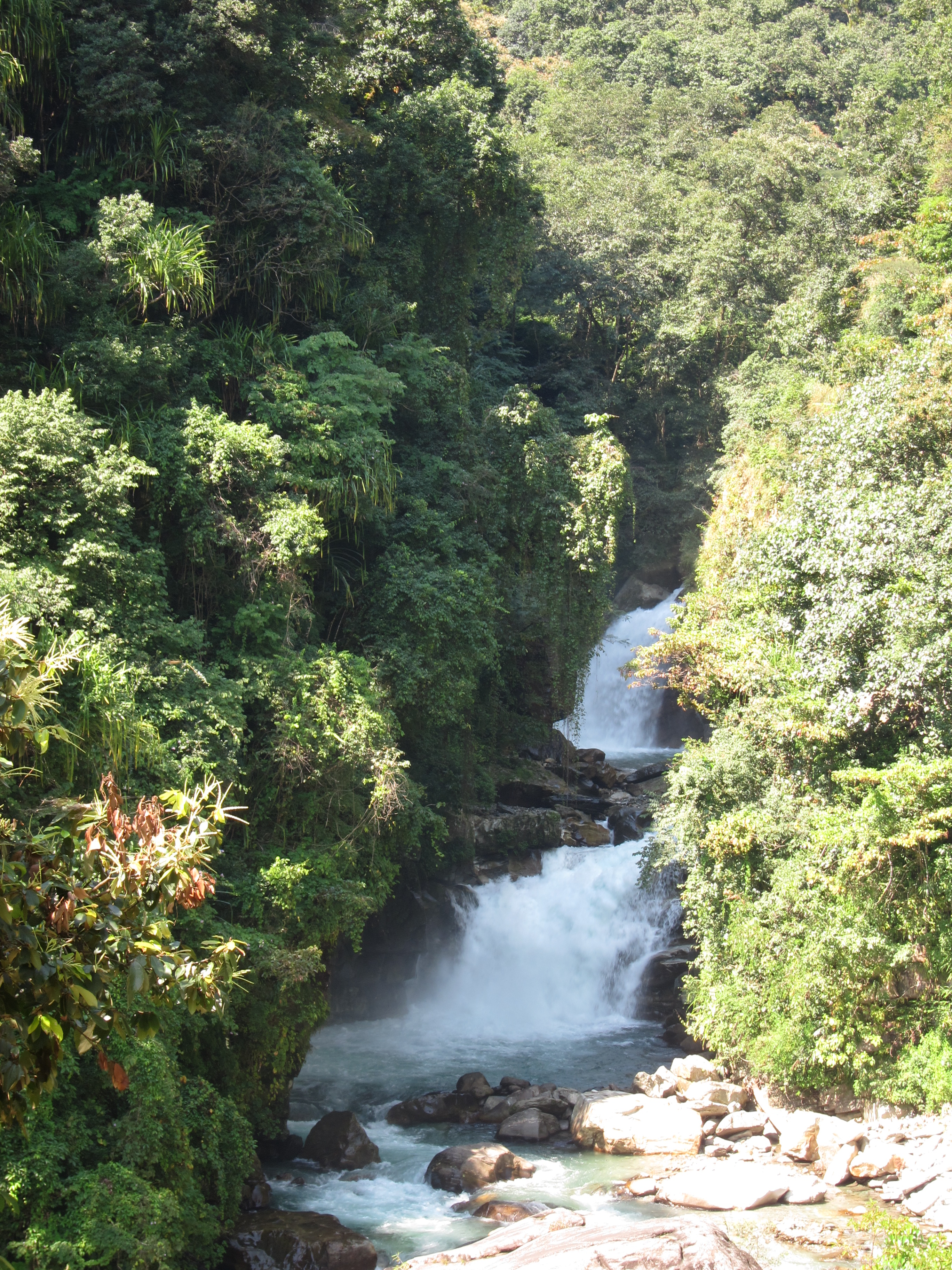
The trek to Ghorepani and Poon Hill is a relatively short trek that reaches an altitude of only 3200 meters (whereas the Annapurna Base Camp trek climbs to around 4100 meters and the entire Annapurna Circuit route reaches as high as 5400 meters). However, from the lookout point at Poon Hill, if the sky is clear one can see practically the entire Annapurna Range in panoramic view. The trek passes through quaint Gurung villages and rhododendron forests, and offers splendid views of valleys, streams, waterfalls and terraced hillsides.
IMG_2496

As the day wore on we climbed the hills and entered areas not accessible to any motor vehicles. We walked through peaceful wooded areas and agrarian villages where the most prominent sounds were of gentle breezes filtering through the trees, flowing streams, children playing, roosters crowing and water buffaloes moaning deeply.

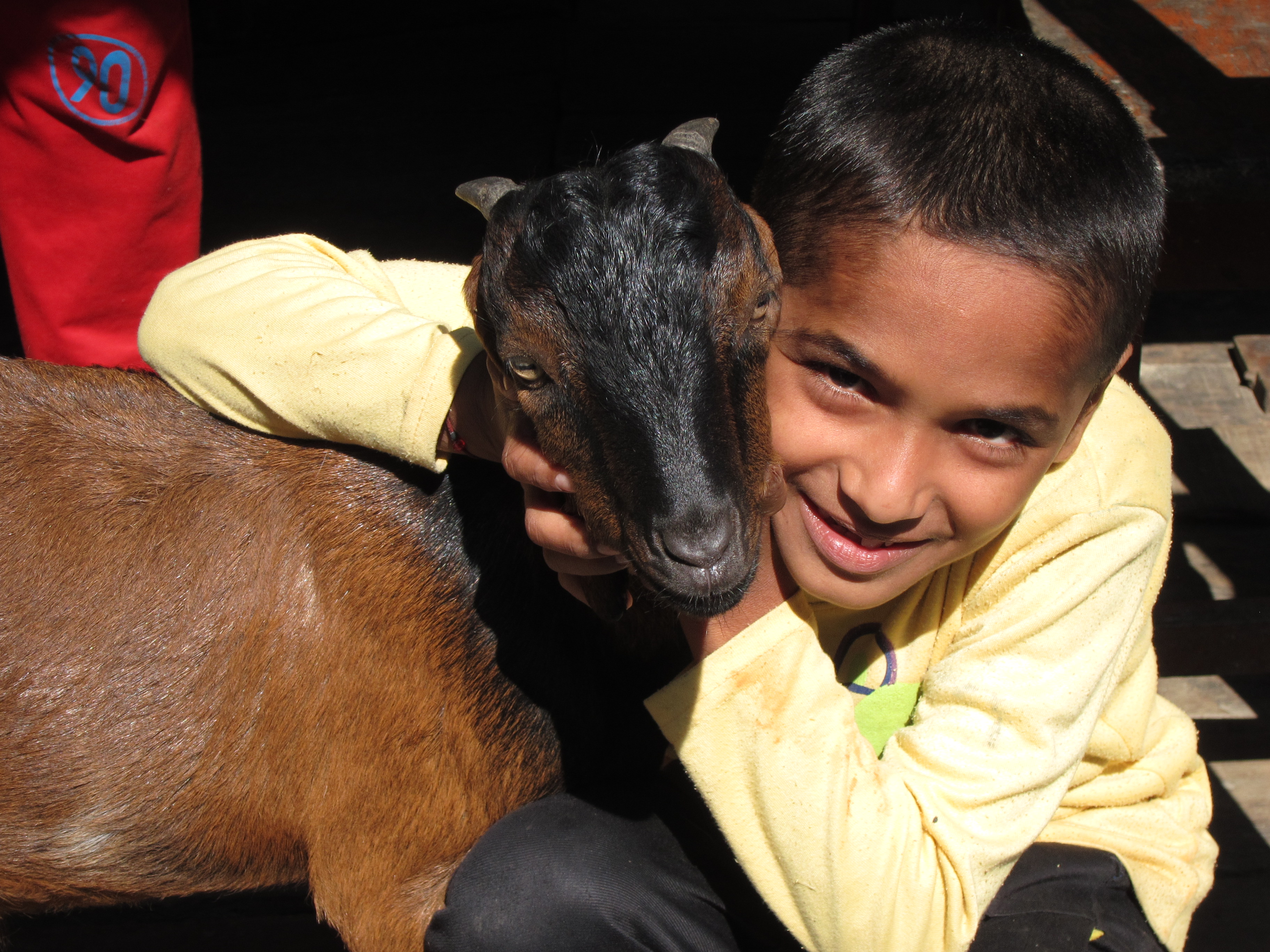
I was taking a photo of this baby goat when the child suddenly inserted himself into the scene. (I hope that goat can breathe! He's got her in a headlock).

I was taking a photo of this baby goat when the child suddenly inserted himself into the scene. (I hope that goat can breathe! He’s got her in a headlock).

As we walked, Mane pointed out various plants, flowers and trees. Alas, the rhododendrons were not in bloom, but I enjoyed carefully inspecting small colorful flowers along the path. Mane showed me one plant that he described as “poisonous” but as the ancient trails were wide and well trodden we would only run the risk of touching this plant if we strayed off the path.

We took rest breaks every few hours. As we were resting on a stony ledge overlooking a valley, another solo traveler and her guide joined us. The woman gave me a friendly smile and asked, “Where are you from?” I told her I was from New York and she giggled. She said she was Korean and then giggled some more. In between her giggling we spoke about our respective trekking plans and compared notes about our prospective itineraries. It seemed we would be taking the same route for the next few days. We parted ways, and before I joined Mane back on the trail, I took a few swallows of water from the bottle in my pack.

For the last few years when traveling I have made great efforts to avoid using bottled water, and to that end I had purchased a small water filtration “straw” and some chlorine tablets. I carried these in my pack along with a one-liter water bottle, so that I would be able to refill along the way.

At another rest stop near a small guest house I asked Mane if there were a spigot where I could refill my bottle. As I would learn over the next few days, Mane was the exceedingly cautious type, and said, “This water no good, no good! You have medicine?” I told him I had a water filter and purification tablets and he seemed satisfied. He directed me to a spigot that had a hose connected to it. The other end of the hose was obscured in the underbrush, and he showed me where it was.

As I reached down to pick up the hose, I heard Mane yell, “Poison plant!” but it was too late. Oowwwwwwwieeee! What was that? I looked down and saw a small innocent looking plant with tiny, soft green leaves and with some even tinier green fuzz along its equally tiny stem. So harmless looking! The end of my left middle finger felt like it had been stung by a wasp and in addition to the pain I felt tingling and numbness. I squeezed my finger to try to force out the poisonous substance but to no avail.

Mane assured me that it would be “better in five minutes” and indeed after several minutes the acute pain had subsided but it would be over 24 hours before I would have full relief from the pain, tingling and numbness. Who knew a small plant packed such a fierce bite?
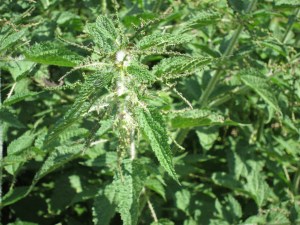
Here is The Culprit, called "Shisnu" in Nepali (aka Stinging Nettle).

Here is The Culprit, called “Shisnu” in Nepali (aka Stinging Nettle).

A few hours later we broke for lunch in a small village. There was my Korean friend relaxing in the dining area! I said hello and she responded with, “Where are you from?” I thought, Didn’t we already cover this? I again told her I was from New York, and said, “You’re from Korea, right?” Suddenly she burst out giggling, then said, “Same person, same person!” She pointed to her eyes and said, “Grasses — grasses!” I had been wearing clip-on sunglasses when we met a few hours earlier. Apparently she had failed to recognize me without them! She continued on into an uncontrollable fit of giggling.

Along with our guides we walked the trail together for the next few hours until we broke for the night at the Gurung village of Ulleri.
IMG_2502

Standard
Uncategorized

Tue 30 Sep 2014

misriram

Mr. Misri Ram, Shoecare Professional. Originally from Bihar, India, he learned English “for business” — a savvy man.

Another nice day — my first day in Pokhara with not a drop of rain! No major activities today. I handled some business, e.g. settling my bill with the hotel, picking up my laundry, doing some banking, and booking into a six-day trek in the Annapurna Conservation Area.

I once again did a lot of walking around Lakeside. The shoeshine man, sitting cross-legged on a small piece of fabric near a telephone pole, greeted me as usual. He called out, “shine for you today, sir!” but once he saw my flip-flops he decided there was not enough real estate there to get a good shine. He was the consummate salesman, always smiling and saying “Namaste,” or “Ni Hau,” and if his prospective customer said, “no, thank you,” he always smiled and said, “maybe tomorrow.”

In fact in my case he was a bit too zealous and if I had heeded his advice my boots may not have been up to the rigors of my upcoming trek. You see, he shined my boots a few days back, and did a fine job. However, as he was finishing, up, he had a concerned look on his face and said, “Sir, here you have stitching, it is coming off!” I was worried, as these were practically new boots, and furthermore, I was planning to rely on them for several days of trekking across mountainous terrain. I looked closely and…wait! there was no actual stitching in the area he was pointing, only a sort of simulated stitching where the rubber sole was glued to the upper. I may not be a shoe expert, but I know that this sort of stitching does not come off, since it is fake to begin with!

But he persisted, and began to get out a fat needle and some thick, sturdy brown twine, saying, “good price, I give you good price!” Now I was worried, but for a different reason. “No, no please, it’s OK, no, not today, just the shine today please!” I somehow managed to get my well-polished boots back on my feet before he poked hundreds of holes in them with his heavy-duty needle. I narrowly avoided having my waterproof Rockports turned into two shiny, black leather sieves!

Standard
Uncategorized

Mon 29 Sep 2014

A Kayak Level View of Fewa Tal

A Kayak Level View of Fewa Tal

To cool off from yesterday’s chili momos I went kayaking today on Fewa Tal. I was considering renting a rowboat since for some reason I thought it would be cheaper than renting a kayak, but after asking around I found out the opposite was true. And in a kayak, you’re right on the water, as if one with the surface of the lake. A fine way to combat dualism.

One of the guys at the kayak rental place helped me take the kayak down to the water a few blocks away. It took me a while to get my sea legs back (or in this case, lake arms) as I had not been kayaking in a while. One of the challenges I faced initially was that periodically for no good reason whatsoever the kayak would just turn around in a complete circle as if it had a mind of its own. There was nothing I could do to stop this — if I fought against the turn in one direction I just ended up spinning out in the other direction. I attributed this to my poor kayaking skills. I finally decided that each time I felt that spinning sensation coming on I would just let the kayak do its thing until I was once again facing the direction I wished to go. Nowhere to go, nothing to do…

I started out rowing toward a small island on one side of the lake, but I decided to just circumnavigate it and not pull into the dock for fear of making a fool of myself trying to get out of the kayak. Then I rowed in the other direction, and as I more carefully observed the surface of the water I noticed tiny little eddies and gentle fluctuations in the little wave patterns. Aha! Therein lay The Mystery of the Spontaneous Spinning. I wondered if things would be different if I were to go in the other direction and I later confirmed this to be true.

I ended up being on the water for about four hours! I was one of only a handful of kayakers out there and I was able to venture to a more placid part of the lake and row around at my leisure, stopping at times to rest and chillax. Coming back I made good time rowing with the current and even though those pesky eddies and whirlpools were still there, I was able to navigate them more easily.

Finally I decided to go onto the tiny island and have a look. It was no more than 50 meters square, and as I got nearer to it I heard chanting and the periodic clang of large bells. I saw colorful decorations and flowers, and smelled incense. Yes, on this baby island there was a baby Hindu temple, just big enough for one person to go inside! I took off my flip-flops and walked clockwise around the temple, spent several minutes taking some photos and relaxing and eventually rowed back to the boathouse. (By the way, I was able to get out of the kayak, and back in, without incident. However a Chinese guy near me was not so lucky. As he was standing up near the dock his kayak capsized and he dove involuntarily into the water with a big splash. As I helped him up I shared with him my Great Fear of Doing Exactly What He Did).

For the rest of the day, standing or sitting, walking or lying down, I had the sensation of gently rocking on an undulating surface of Water, Himalayan Water.

Placid Waters...

Placid Waters…

Guarding the Tiny Temple

Guarding the Tiny Temple

Standard
Uncategorized

Sun 28 Sep 2014

Momos!

Momos!

Today I did very little. I was tired from yesterday’s hike up to the Peace Pagoda so I slept in a bit. Then I ventured out to wander around the lakeside and take some photos of the lake and nearby mountains. Above the hills in the distance was the striking peak of Machhapuchchhre (Fishtail Mountain), almost 7000 meters at its apex, jutting up like a carved white arrowhead between some clouds. I took a few photos but was unable to get a good shot due to the clouds.

I bought some postcards and stamps at a local bookstore, then had a pot of tea on the balcony of the Rainbow Restaurant near my hotel while I addressed and wrote notes on the cards. From my perch on the balcony I had a good view of the Peace Pagoda in the distance.

As usual, the waiter at the restaurant asked where I was from, and we spoke briefly about his interest in hip-hop culture, which originated in the South Bronx (I gathered from our talk that he had no idea of its origins, nor any idea of where the South Bronx was!). He pointed to his low-slung jeans, and, palms down, waved his arms around a bit, as if he were a Nepali rapper.

Given that this is a tourist town, it is not surprising that local people would ask where I am from. However, they almost always seem dubious of my answer. After all, how could a brown desi-looking dude be from New York?

Here is a standard scenario: “Where you from?” New York, I say, and receive a blank stare. Maybe they don’t know of New York? I then clarify by saying, “I’m from the USA.” Then, “You look like Nepali.” I tell them my family is from India, but that I was born and grew up in the USA. Blank stare. Then, “Yes, yes, India, your face: Indian. You from India! Which part?” I tell them I have family in Bangalore. They ask, “You have house in Bangalore?” I tell them I stay at my relatives’ home there when I visit. “No house? then where you live?” I decide this is a losing battle and try to end the conversation. But next, “You speak Hindi?” I tell them no, I don’t speak Hindi. They look very suspiciously at me then say, “You Indian, but don’t speak Hindi?!” After this I never quite know what to say. I see pity in their eyes as the homeless desi who can’t speak his own language says goodbye in English and walks off down the street.

This evening I decided to try the “chili momos” at a local restaurant, on the recommendation of Gus, the Dam Guy. Wherever they served momos, I noticed that the menu listed three types: steamed, kothey and chili. The basic momo is a steamed half-moon shaped dumpling filled with your choice of meat or vegetables. “Kothey” dumplings are steamed, then pan-fried on one side. Chili momos are kothey momos doused in a chili-tomato sauce.

When the waiter came over, I ordered a lemon soda, then the chili momos. “Wedge or Buff?” he asked. What could he mean? “I’m sorry could you repeat that please?” I asked. “Do you want wedgetable or buffalo inside?” Ah yes, of course. “Thank you, I’ll have the wedge, um, veg please.”

The momos arrived covered in a rich, dark sauce, interspersed with chunks of sautéed green peppers and onions, and garnished with a few slices of raw cucumber and carrots. They were very tasty, but hot, hot, HOT!! I used the lemon soda to cool down, and when that proved ineffectual, I found the slices of cucumber provided a temporary respite. Now I know what “cool as a cucumber” really means! By the time I finished, I was sweating, my nose was running, my eyes watering, smoke was rising around me, and I was in grave danger of Spontaneous Human Combustion. But I did enjoy the momos and I plan to go back for more! They were every bit as good as Gus suggested.

Hot Momos!

Hot Momos!

Me & Momos

Me & Momos

Standard